The Story Behind
A Neoclassical Legacy Estate Commanding the Pacific Horizon
There are homes that impress, and then there are estates that endure. 3300 Palos Verdes Dr. W belongs firmly to the latter category — a residence conceived not as a transaction, but as a monument to craft, permanence, and the finest traditions of European domestic architecture.
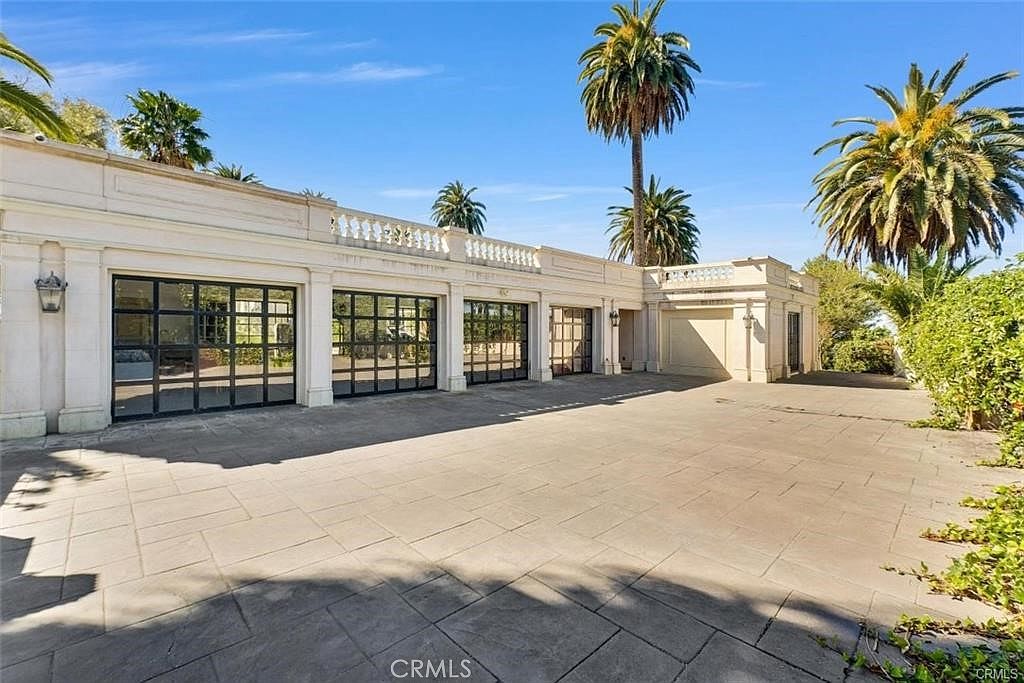
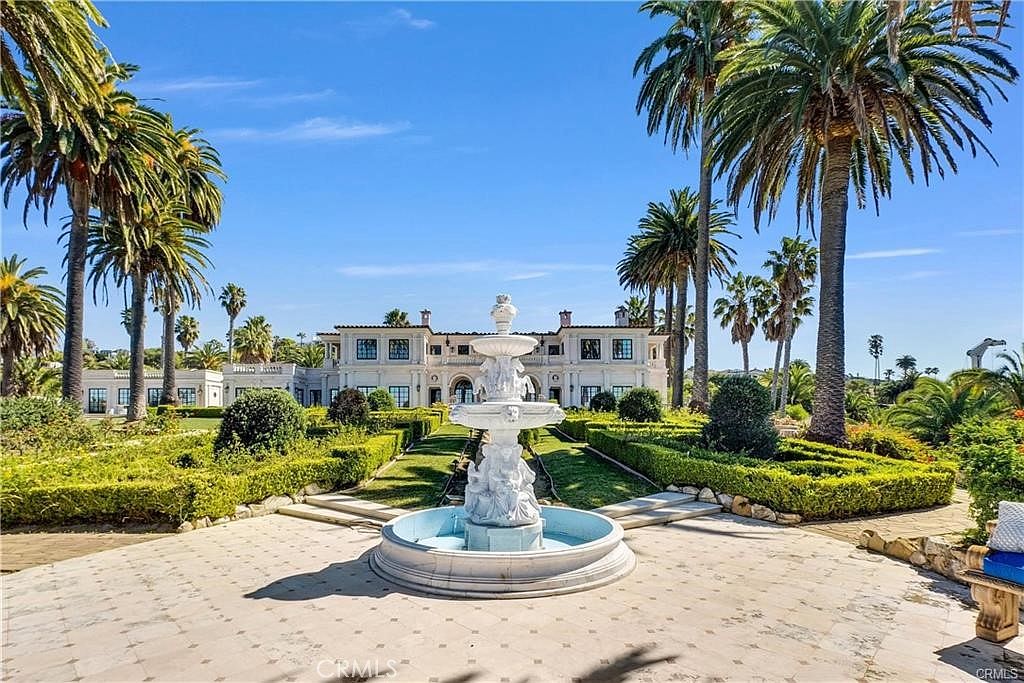
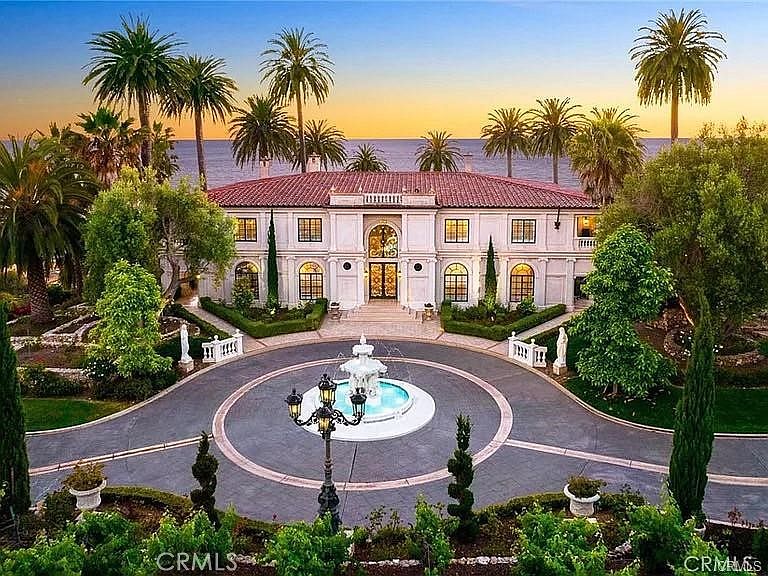
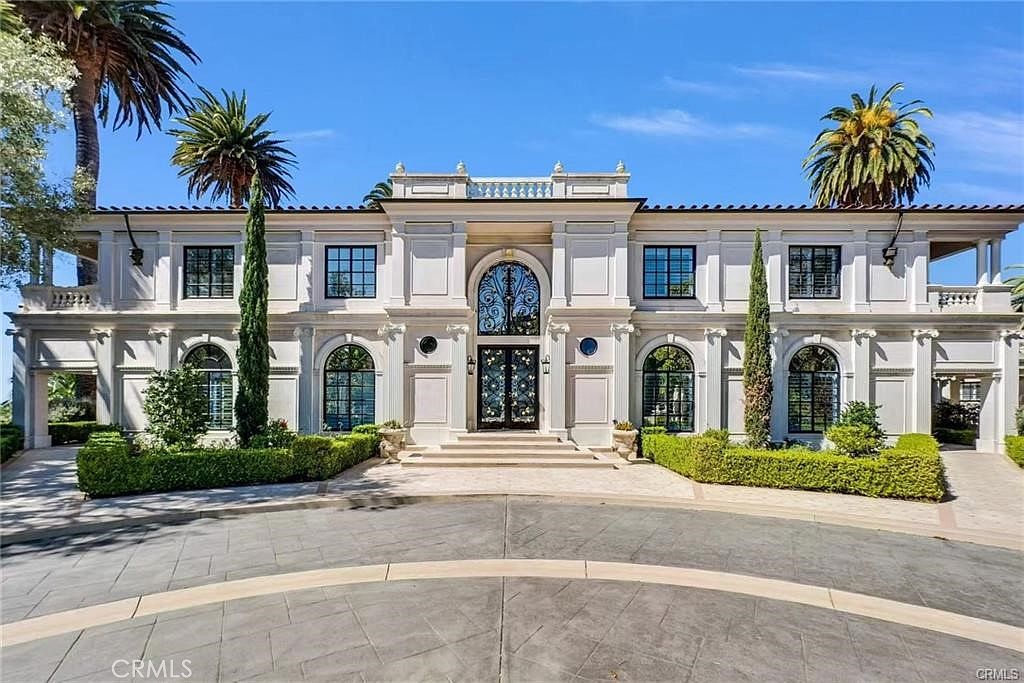
The arrival sequence alone signals that this property operates by a different set of standards. Ornate wrought-iron gates, framed by stone-clad pillars crowned with decorative spheres and wall-mounted lanterns, open to a sweeping circular motor court anchored by a multi-tiered stone fountain. Slender cypress trees flank the arched main entry, their vertical forms reinforcing the home's sense of ceremony and symmetry — a composition more reminiscent of a Loire Valley château than a Southern California address.
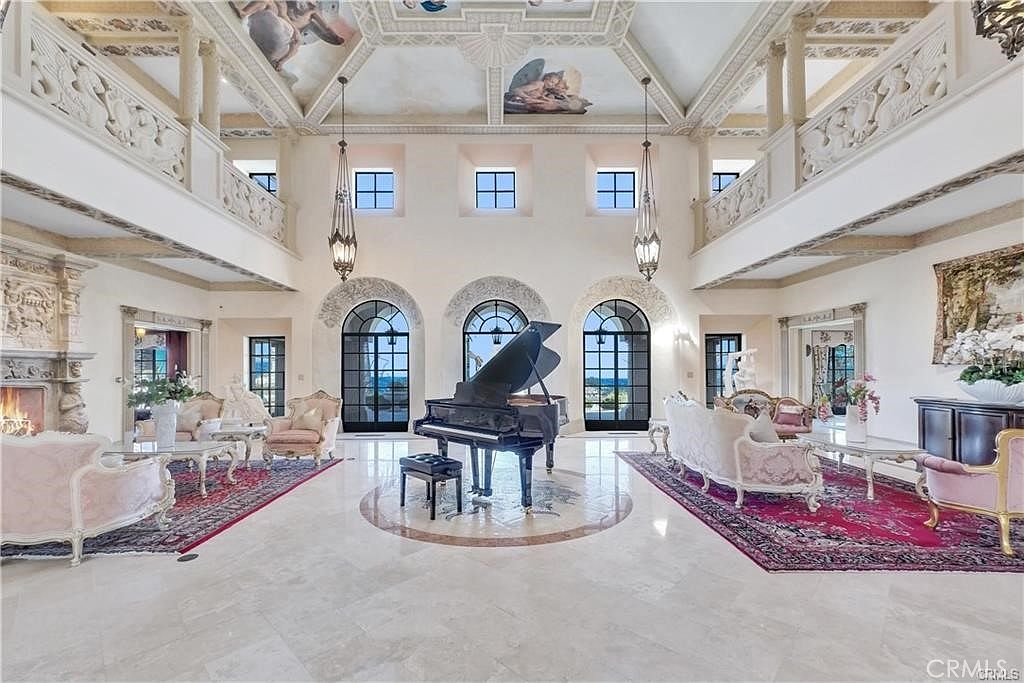
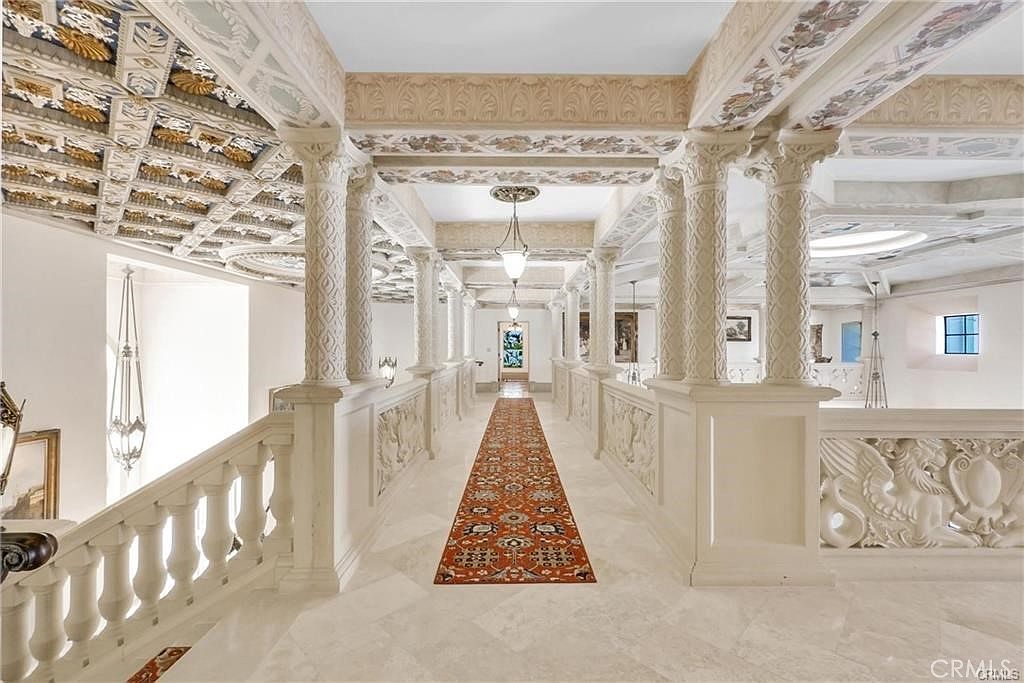
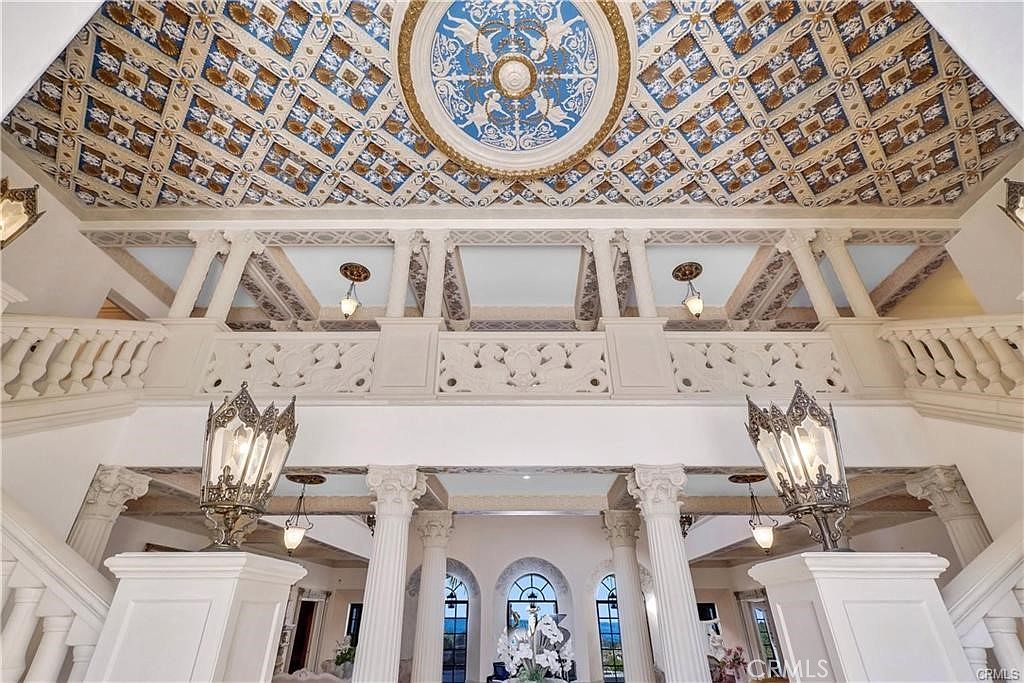
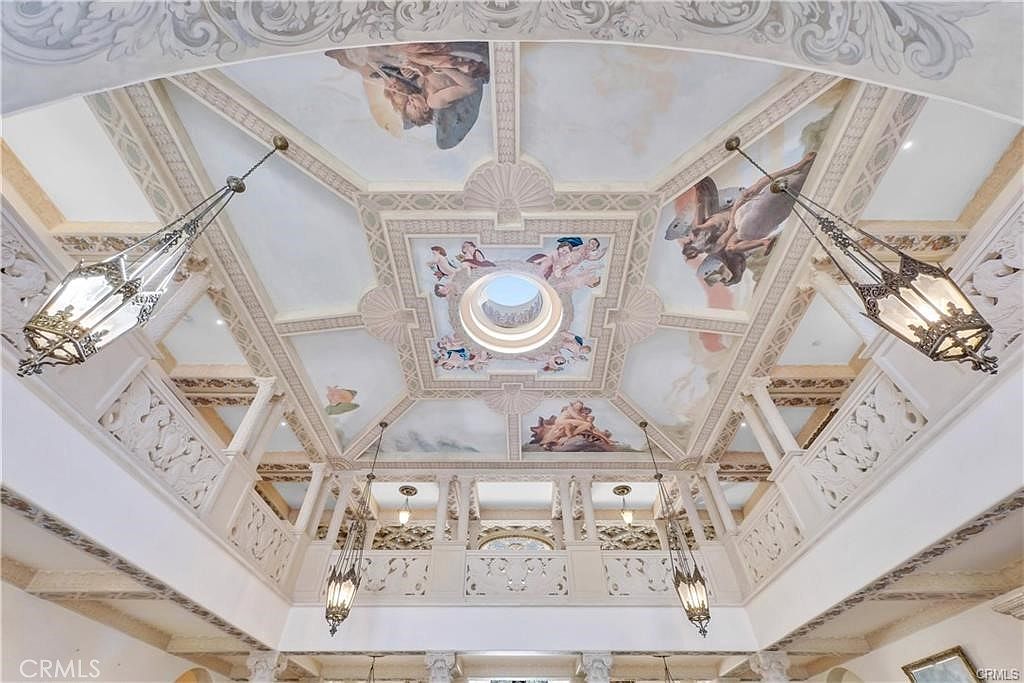
Step through the arched entry doors and the scale of the residence reveals itself immediately. The grand double-height hall rises beneath hand-painted ceiling frescoes of extraordinary detail, depicting classical figures and cherubs within an elaborate architectural surround. A central skylight draws natural light down through the layered coffered ceiling, while twin chandeliers cast a warm glow across polished stone floors inlaid with decorative borders. Symmetrical balconies overlook the main floor from above, and a grand piano rests at the room's center on a circular stone medallion — an arrangement that feels both intimate and palatial.
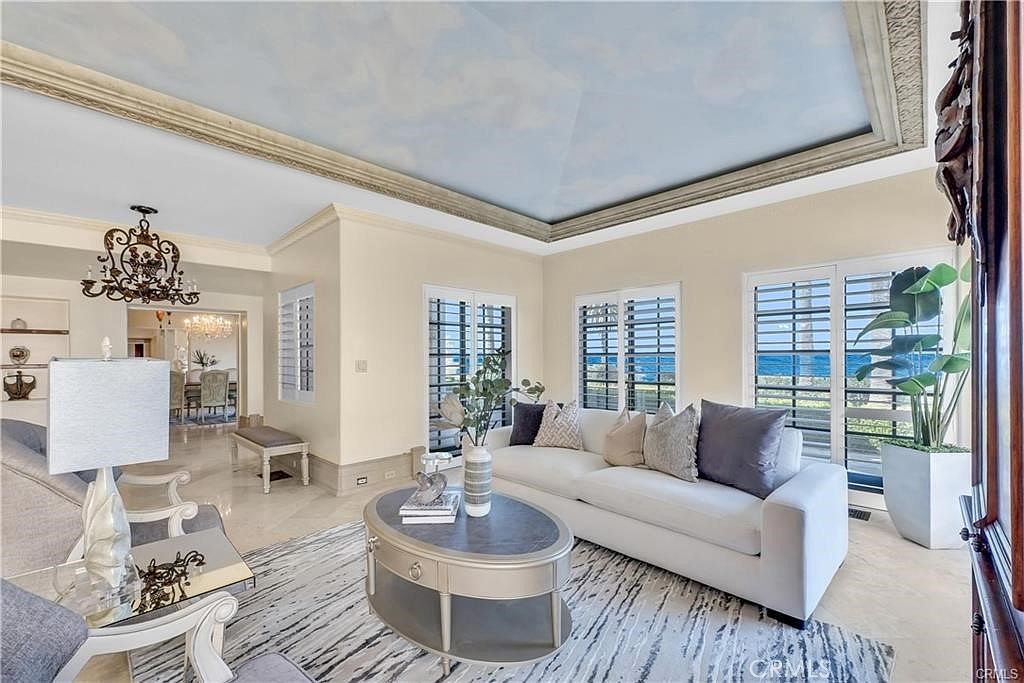
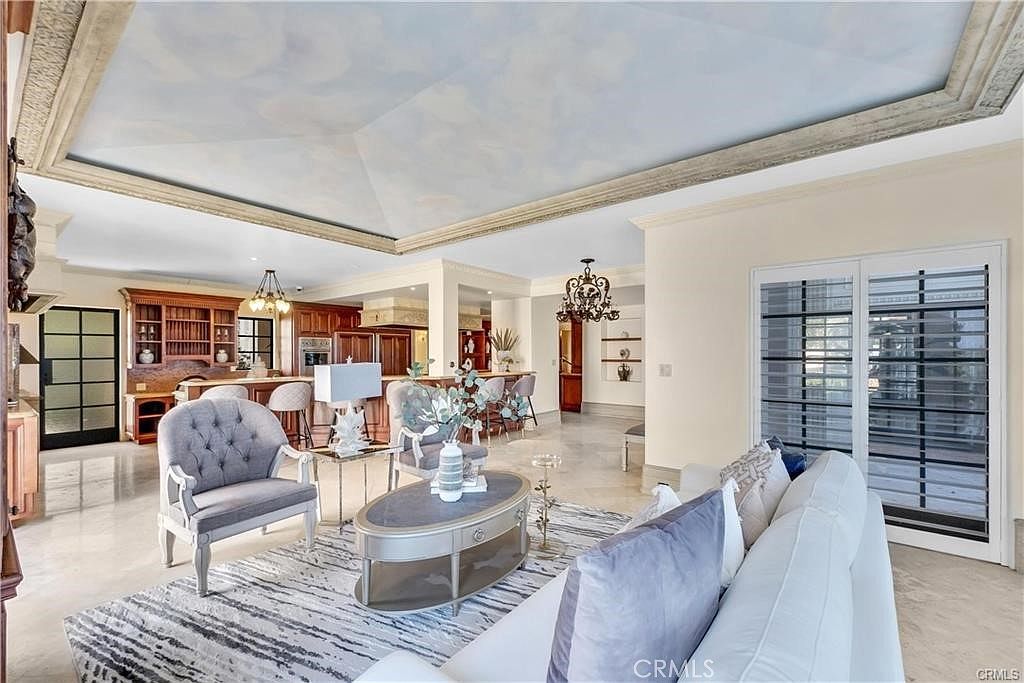
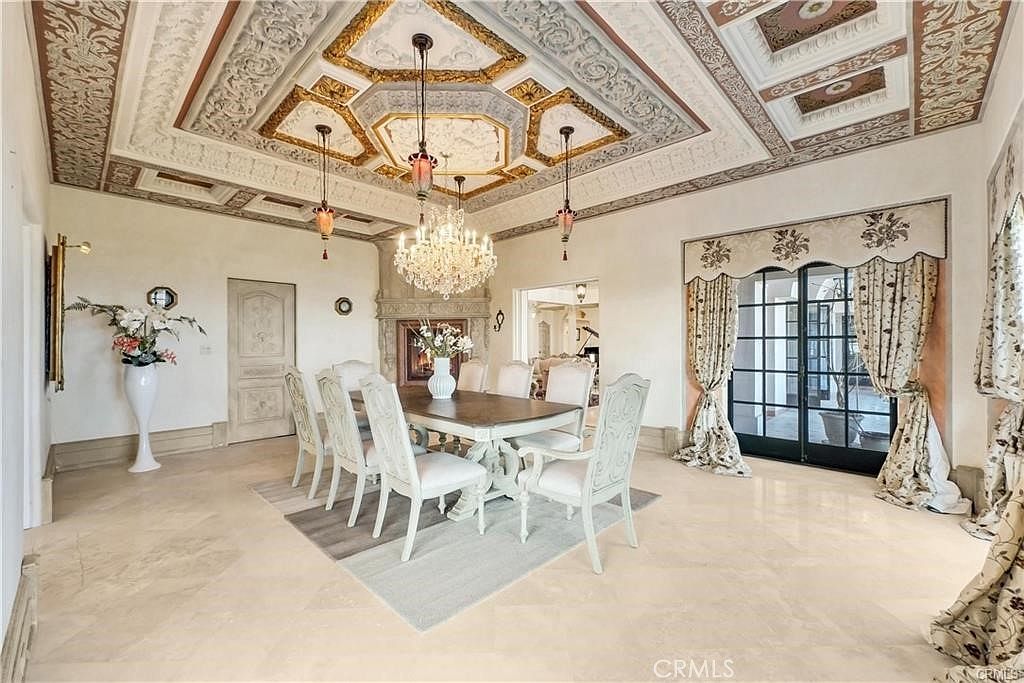
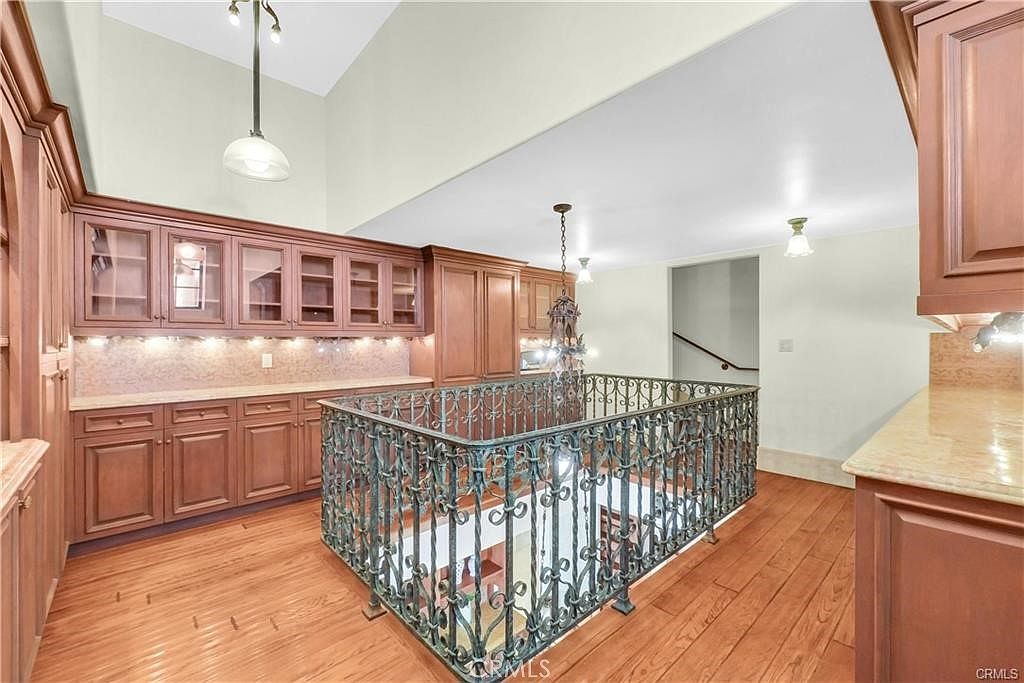
Throughout the residence, the craftsmanship is consistent and uncompromising. The formal dining room presents a coffered ceiling enriched with gold-leaf detailing, a sculpted stone fireplace, and a crystal chandelier of significant scale — a room designed explicitly for the ritual of formal entertaining. The kitchen, by contrast, offers professional-grade appointments within a traditional aesthetic: a large central island, rich warm-toned cabinetry, light stone countertops, and a decorative wrought-iron balcony that overlooks the space from above, adding an unexpected architectural layer to a functional room.
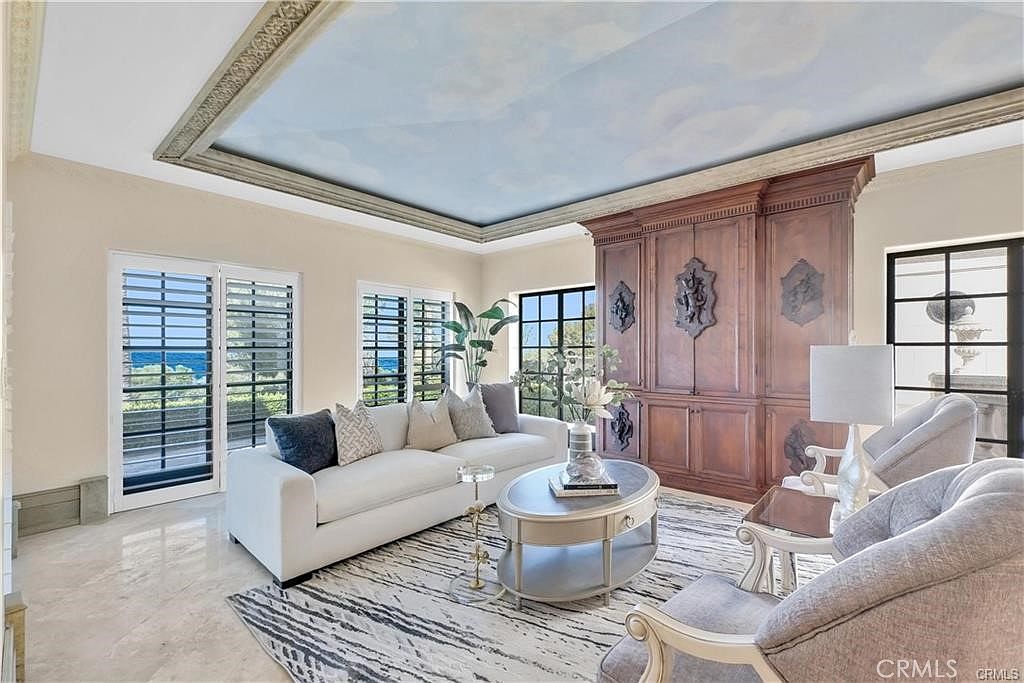
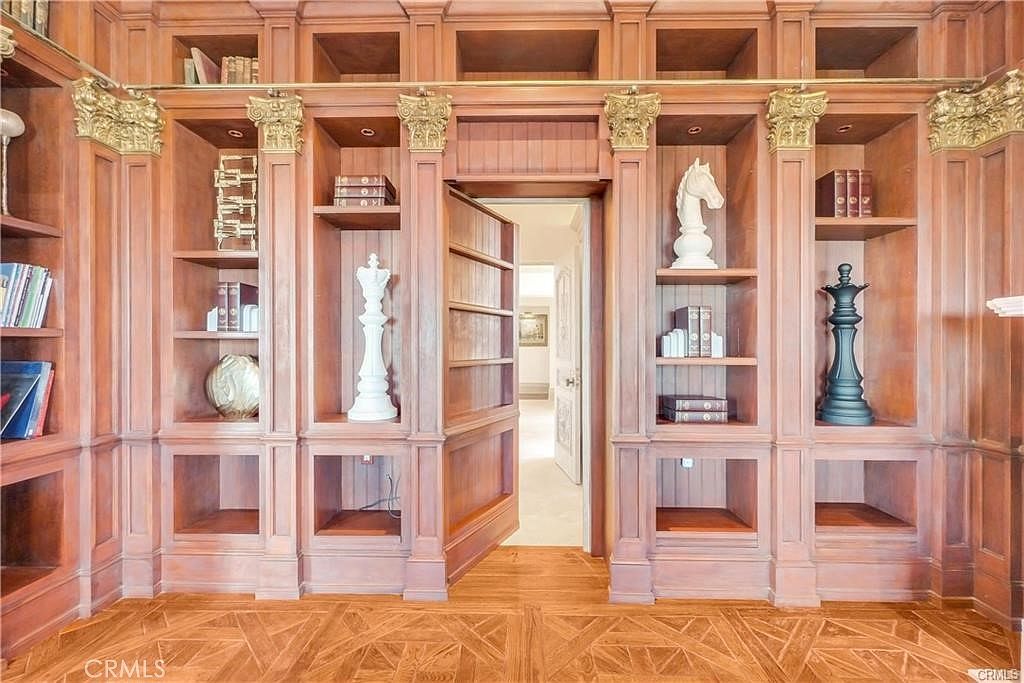
The wood-paneled study is among the estate's most distinguished spaces — a room of genuine scholarly atmosphere, with built-in bookshelves accessible by a rolling library ladder, a sculpted stone fireplace, a deeply coffered ceiling with decorative medallions, and large glass doors that open directly to ocean views. It is the kind of room that rewards extended occupation.
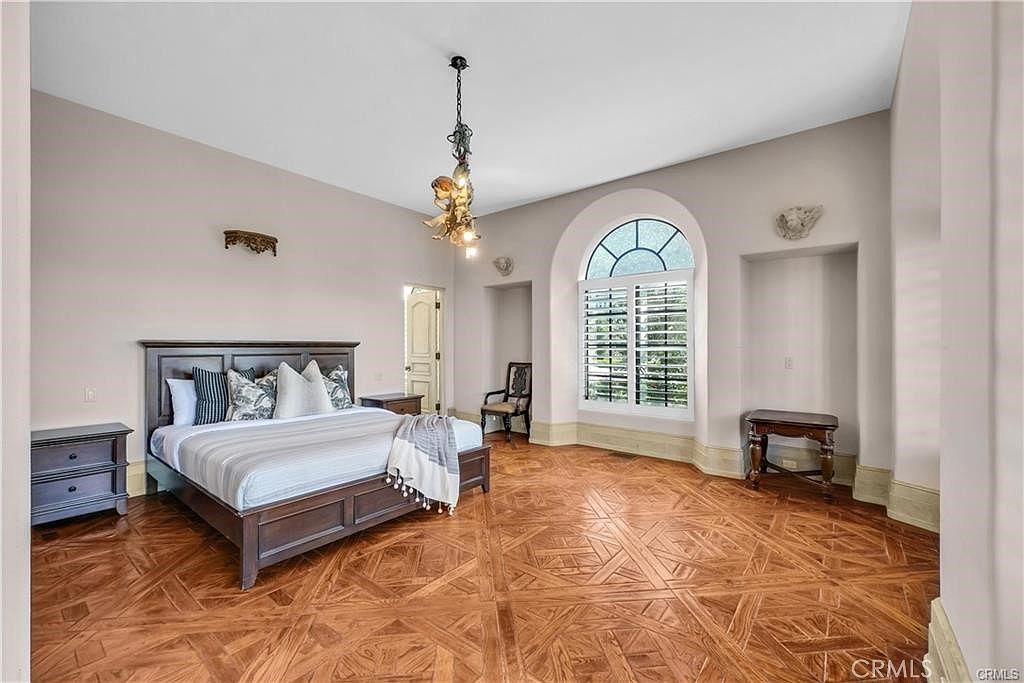
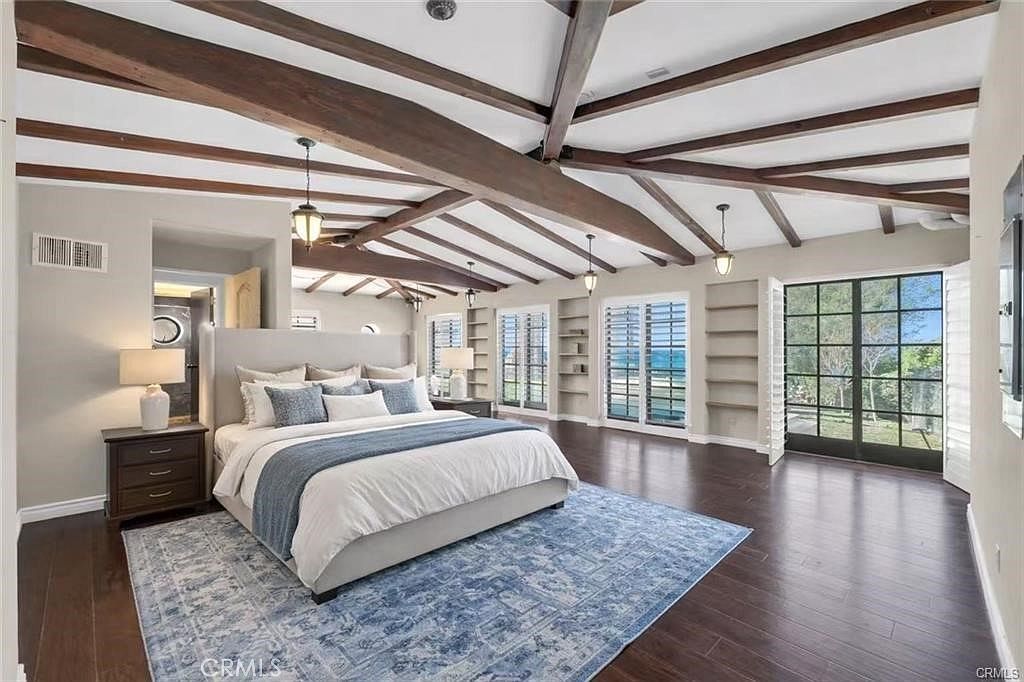
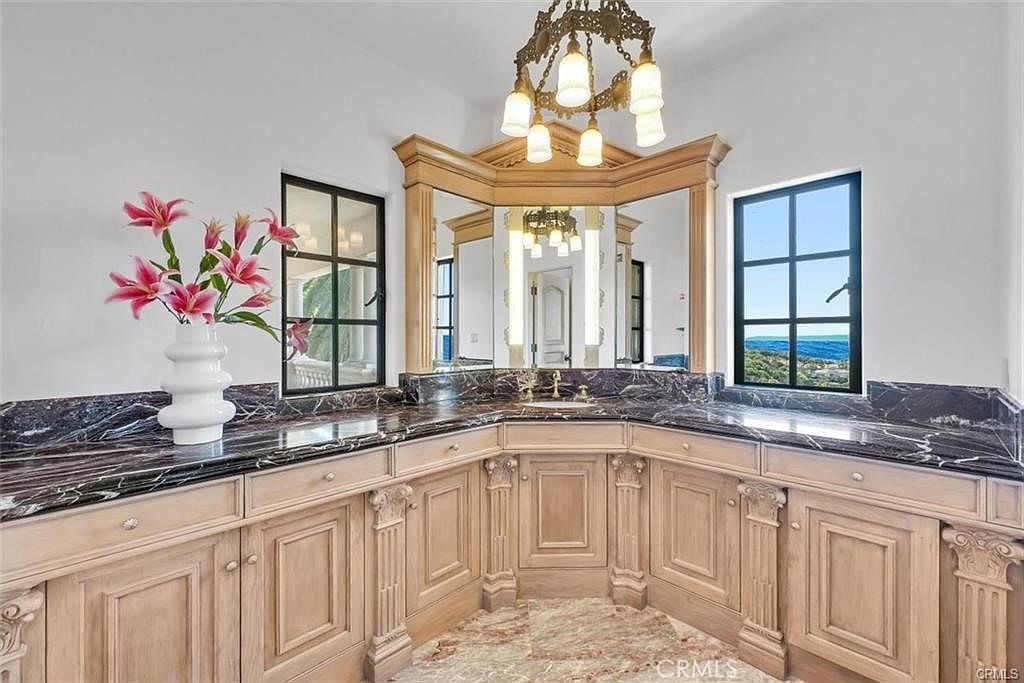
The primary suite continues the estate's commitment to elevated living: parquet wood flooring of intricate geometric pattern, a carved white fireplace, ornate gold-toned drapery, and a stone-clad walk-in shower positioned to frame the Pacific through a dedicated window — a detail that elevates the mundane into the meditative.
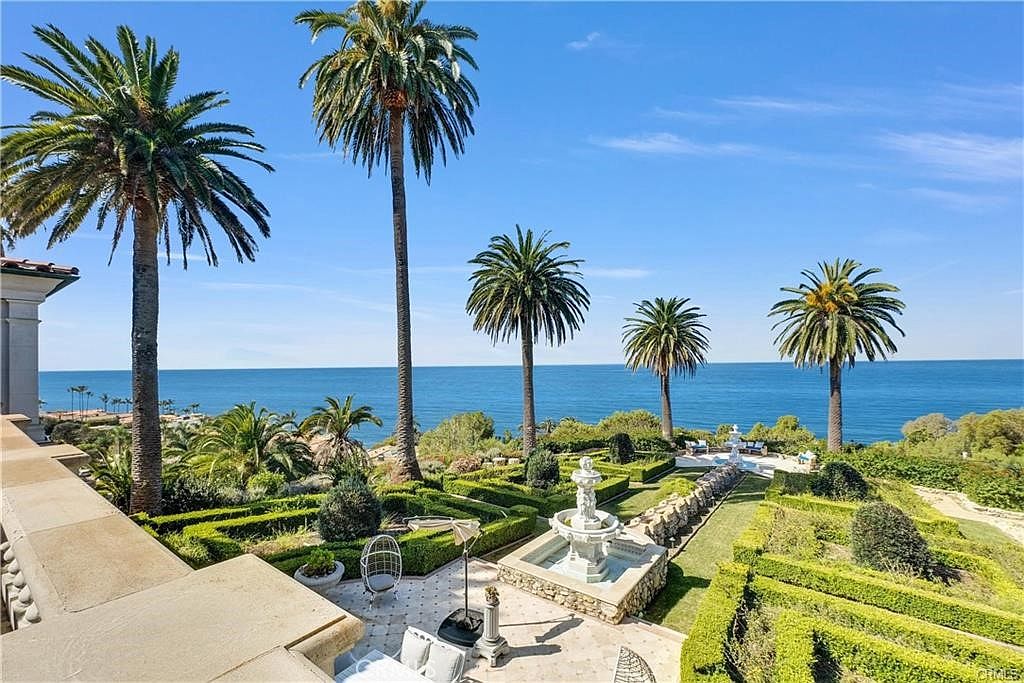
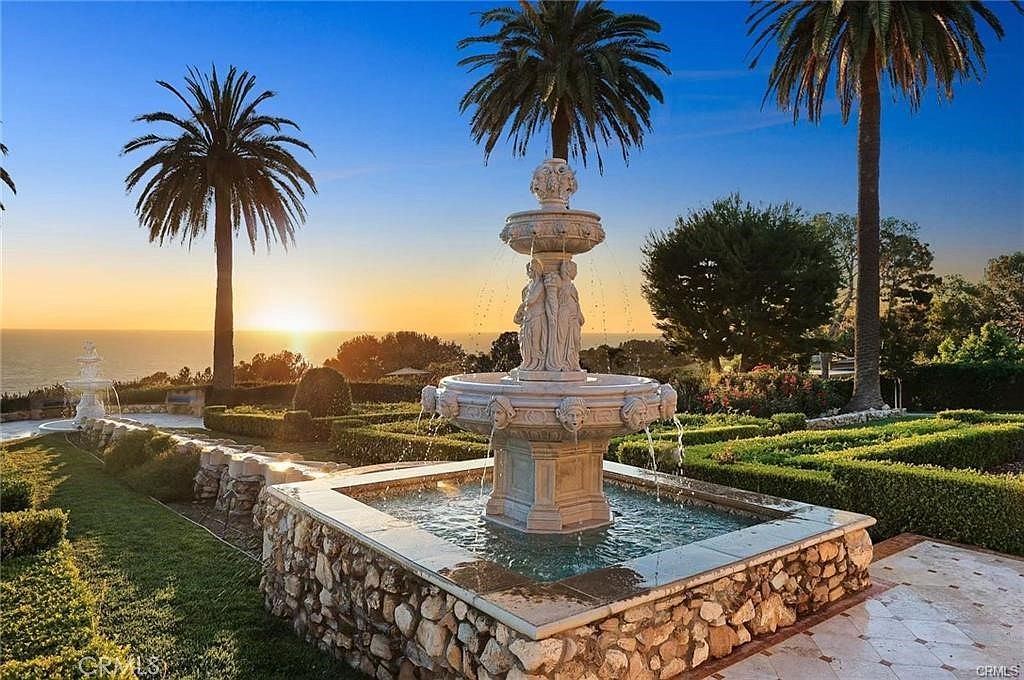
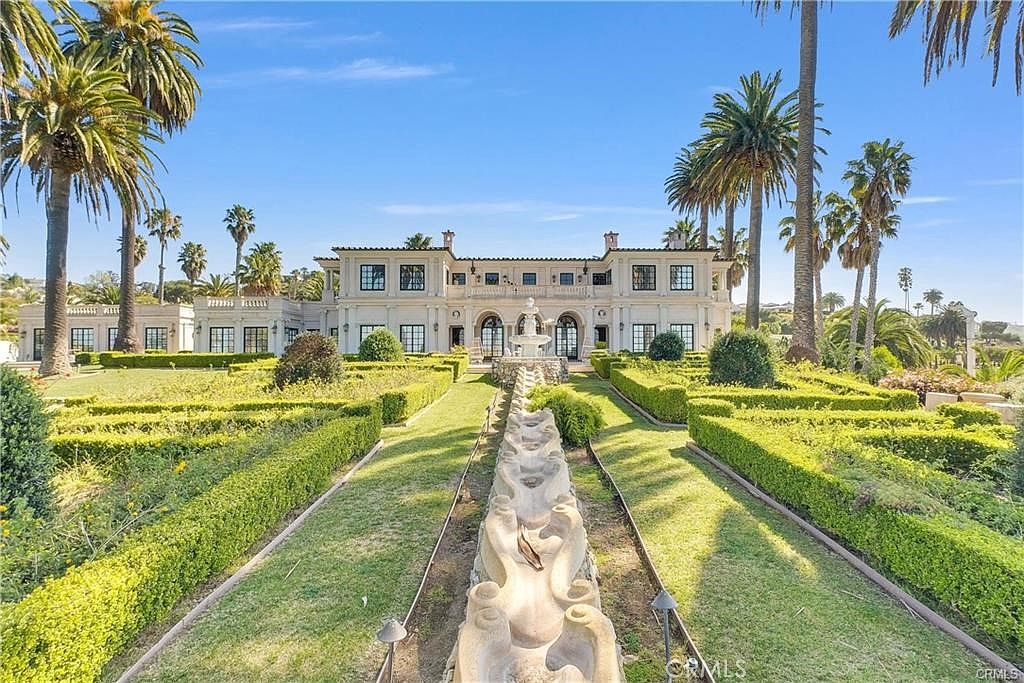
Outside, the formal garden is composed with the axial discipline of classical European landscape design. Geometric boxwood hedges frame a central tiered stone fountain, with stone-paved terraces and glass-railed overlooks extending the living space toward the ocean horizon. At sunset, the fountain catches the fading light against the deep blue of the Pacific — a view that no photograph fully captures and no price per square foot adequately measures.
This is an estate defined not by its dimensions, but by its depth of character.
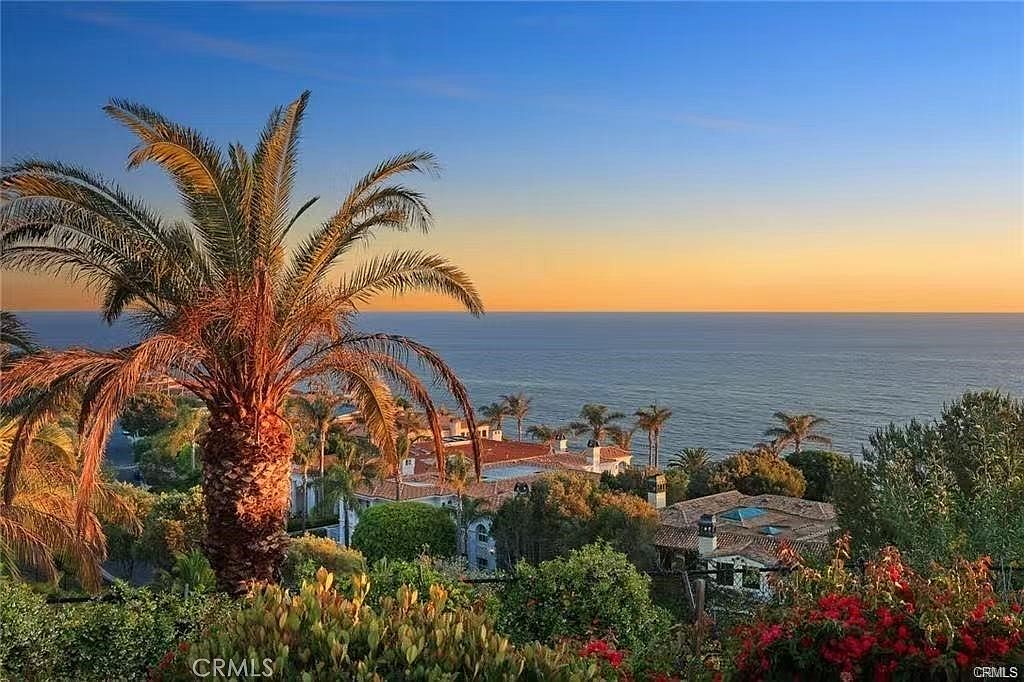
The Palos Verdes Peninsula occupies a singular position in the geography of Southern California — a dramatic promontory rising from the Pacific coastline southwest of Los Angeles, defined by rugged sea cliffs, rolling hills, and an atmosphere of deliberate remove from the metropolitan sprawl that surrounds it. Rancho Palos Verdes, the municipality in which this estate is situated, is among the most scenically distinguished communities in the greater Los Angeles region, and Palos Verdes Drive West represents its most prestigious coastal address.
The peninsula's development as a planned community began in the 1920s under the vision of landscape architect Frederick Law Olmsted Jr. and the Vanderlip family, who sought to create a refined residential enclave guided by strict architectural and landscape standards. That foundational commitment to quality and cohesion remains evident today. The Palos Verdes Peninsula is governed by some of the most protective residential covenants in Southern California, preserving the character of its neighborhoods and ensuring that the natural landscape — the ocean views, the native coastal sage scrub, the dramatic bluff topography — remains the defining feature of every address.
Palos Verdes Drive West winds along the western edge of the peninsula, offering residents some of the most expansive and unobstructed ocean views available on the California coast. On clear days, the Channel Islands are visible on the horizon, and the arc of Santa Monica Bay stretches northward toward Malibu. The Palos Verdes coastline is also home to the iconic Wayfarers Chapel, a landmark glass structure designed by Lloyd Wright that draws visitors from around the world, as well as the historic Point Vicente Lighthouse, which has guided mariners since 1926 and remains a beloved local landmark.
The surrounding community reflects the peninsula's longstanding appeal to discerning residents. The Palos Verdes Peninsula is served by its own highly regarded public school district, consistently ranked among the strongest in California, and is home to Marymount California University and the Norris Theatre for the Performing Arts. The Palos Verdes Golf Club and the Los Angeles Equestrian community maintain a presence on the peninsula, contributing to a lifestyle that balances outdoor recreation with cultural engagement.
For those drawn to the ocean, the coastline offers tide pools, hiking trails along the Palos Verdes Bluff Trail system, and access to coves favored by divers and kayakers. The nearby communities of Palos Verdes Estates and Rolling Hills Estates offer boutique dining, specialty retail, and a village-scale civic life that stands in deliberate contrast to the commercial intensity of broader Los Angeles.
Yet for all its sense of seclusion, the peninsula remains within practical reach of the region's major cultural and commercial centers. Downtown Los Angeles, Beverly Hills, and Los Angeles International Airport are each accessible within a reasonable drive, making Rancho Palos Verdes an address that offers genuine coastal retreat without geographic isolation.
To own on Palos Verdes Drive West is to occupy one of the rarest positions in Southern California real estate — a coastal bluff address where the Pacific defines both the view and the way of life.
Featured Highlights
Curated Content • Presented by HE GEORGE GAO