The Story Behind
A Floating Crown Above the Bay, Framing Everything
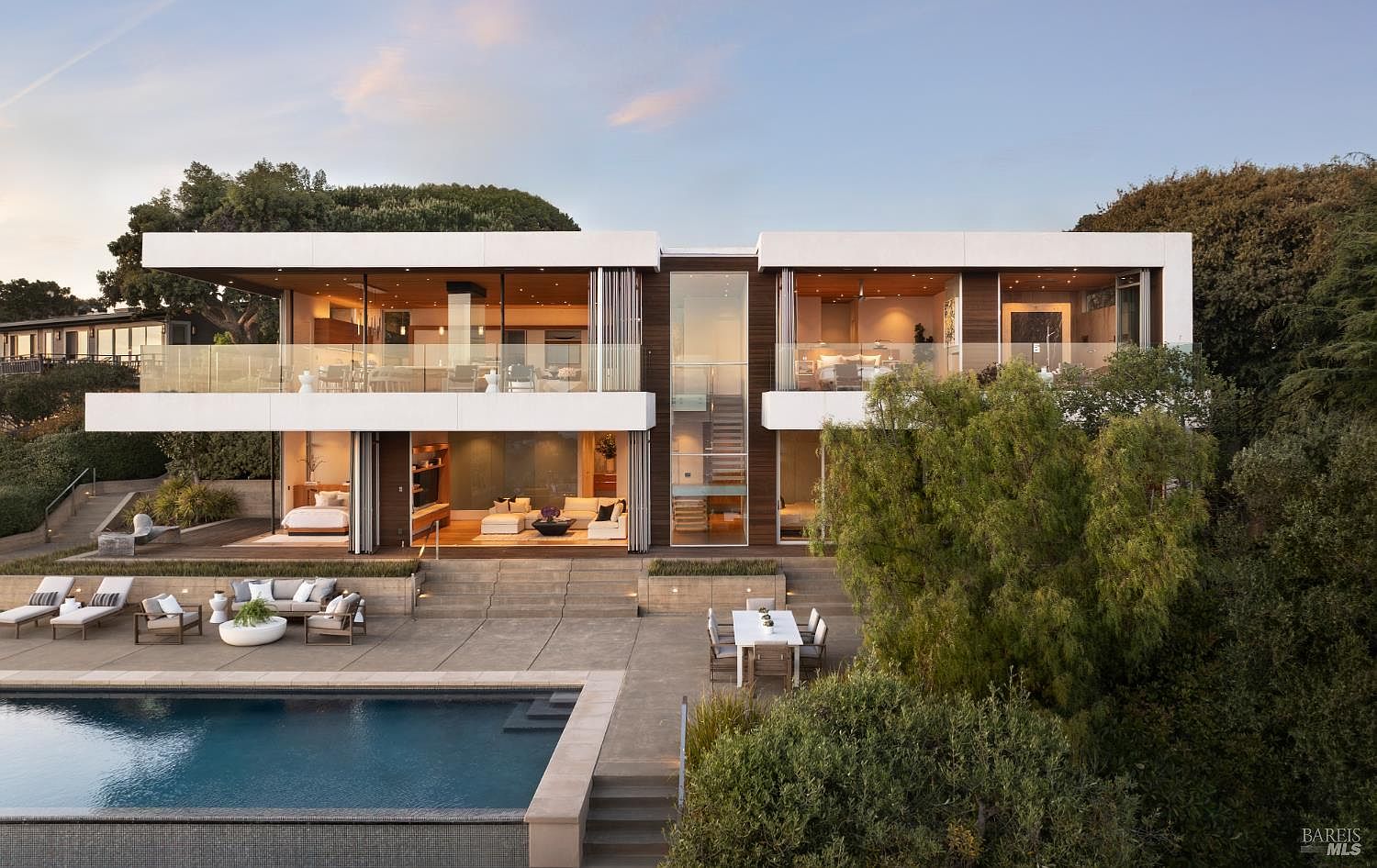
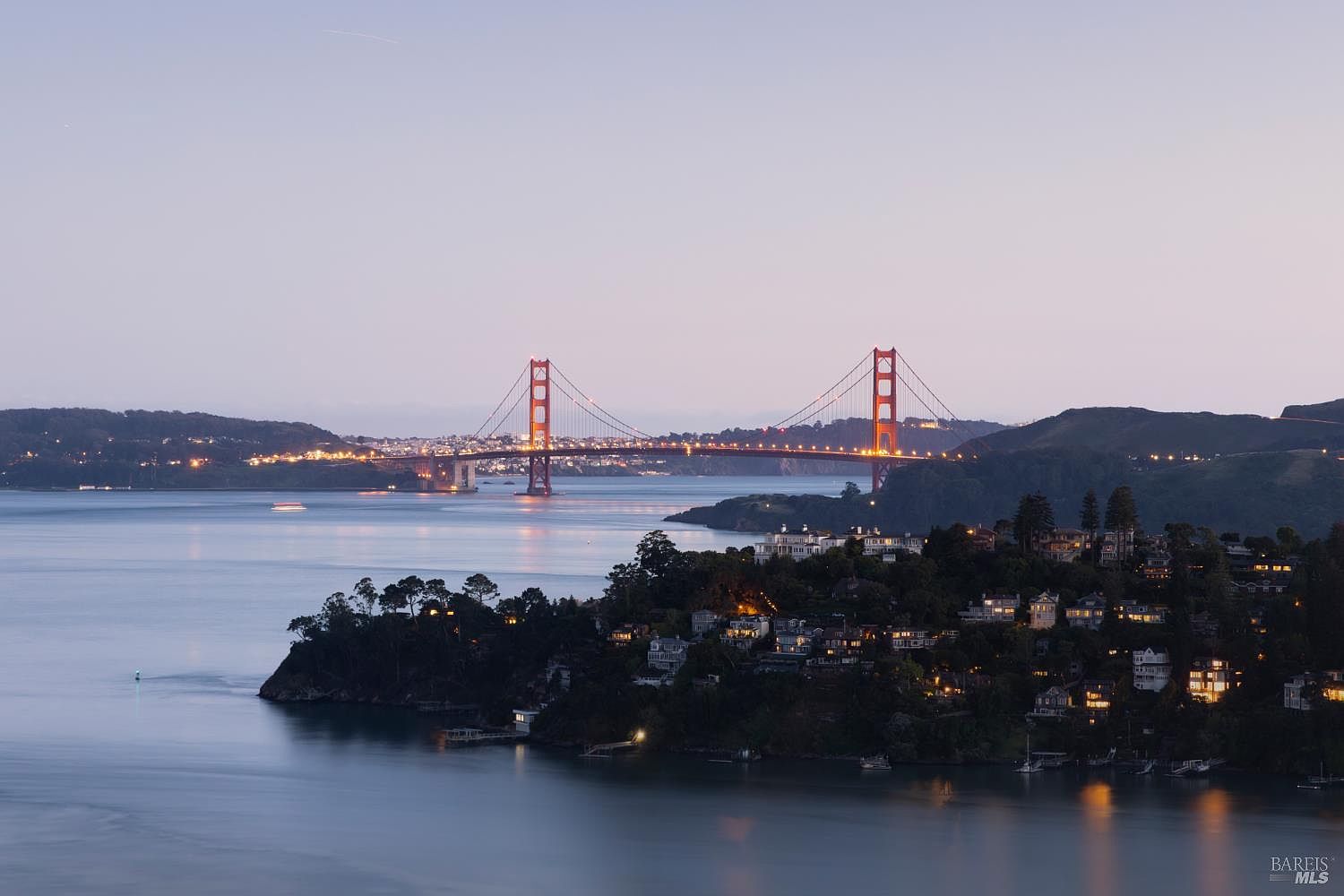
There is a particular kind of architecture that does not merely occupy a site but enters into conversation with it. At 1860 Mountain View Drive, that conversation is constant, and the view always has the first word. Positioned at the crown of the Tiburon Peninsula, the residence is built on a cantilevered steel structure that projects the home outward from the hillside, creating the impression — from the terrace, from the pool deck, from nearly every interior room — that the building floats above the Bay. It is not a trick of styling. It is an engineering commitment made in service of a single idea: that nothing should interrupt the relationship between this house and its horizon.
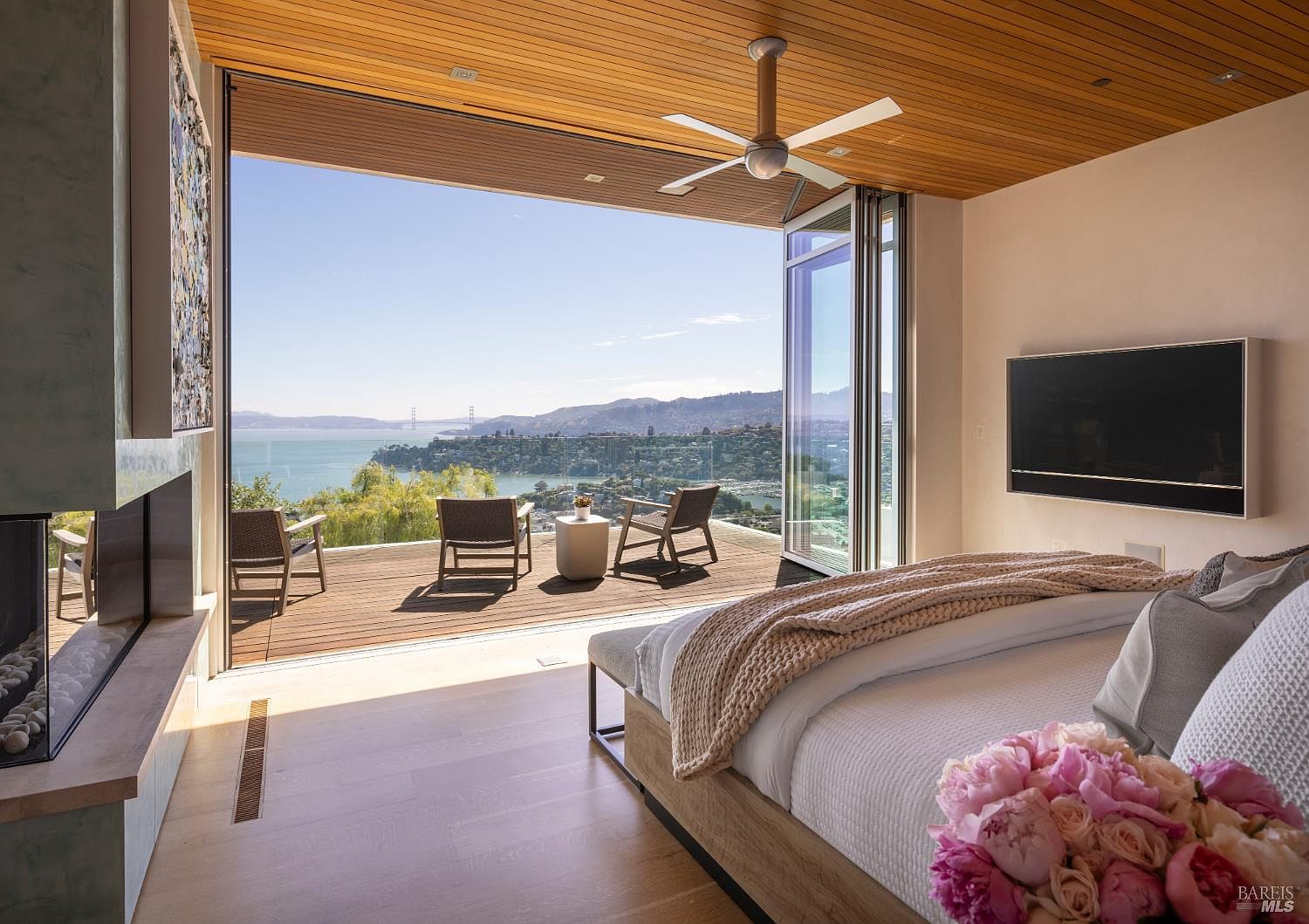
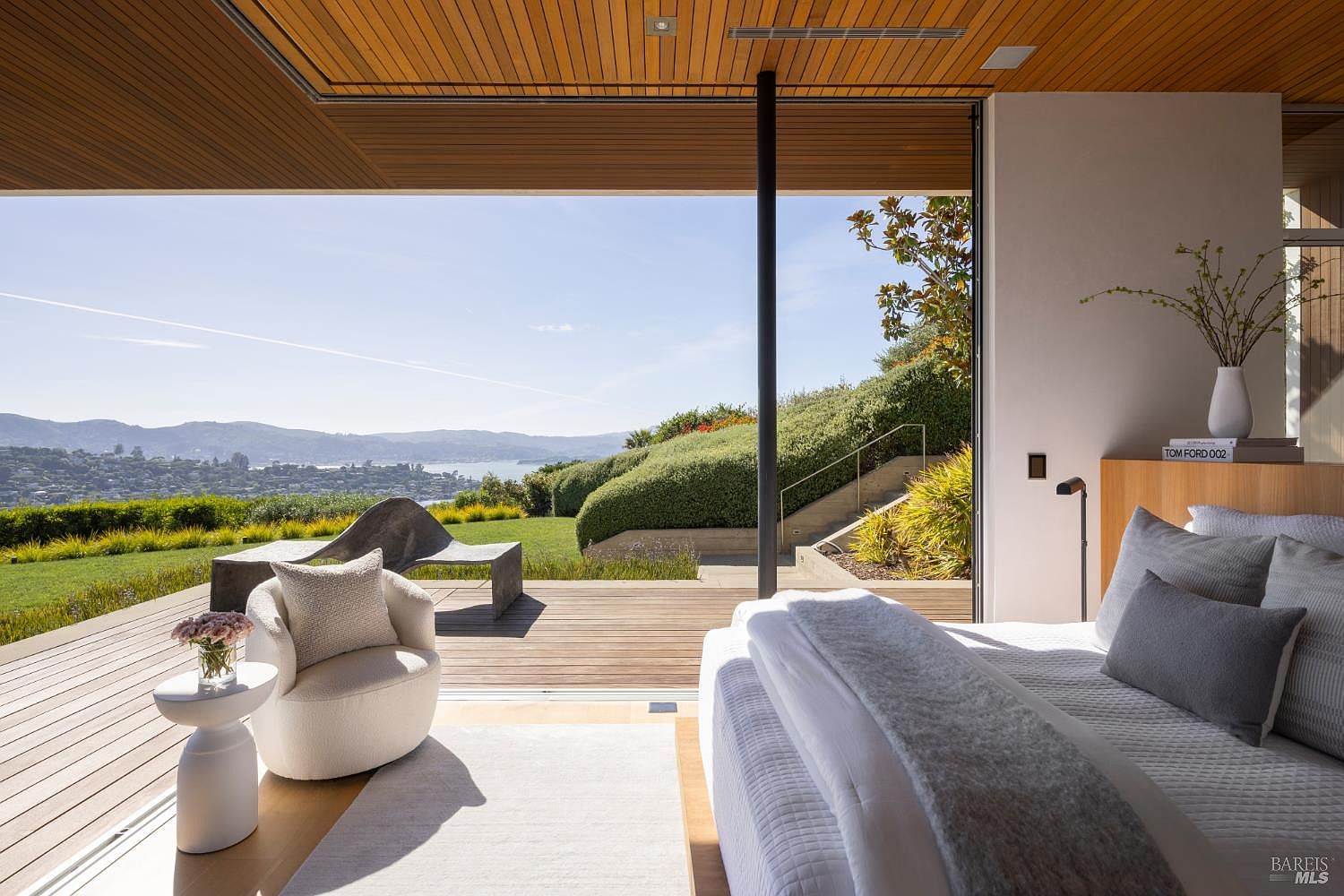
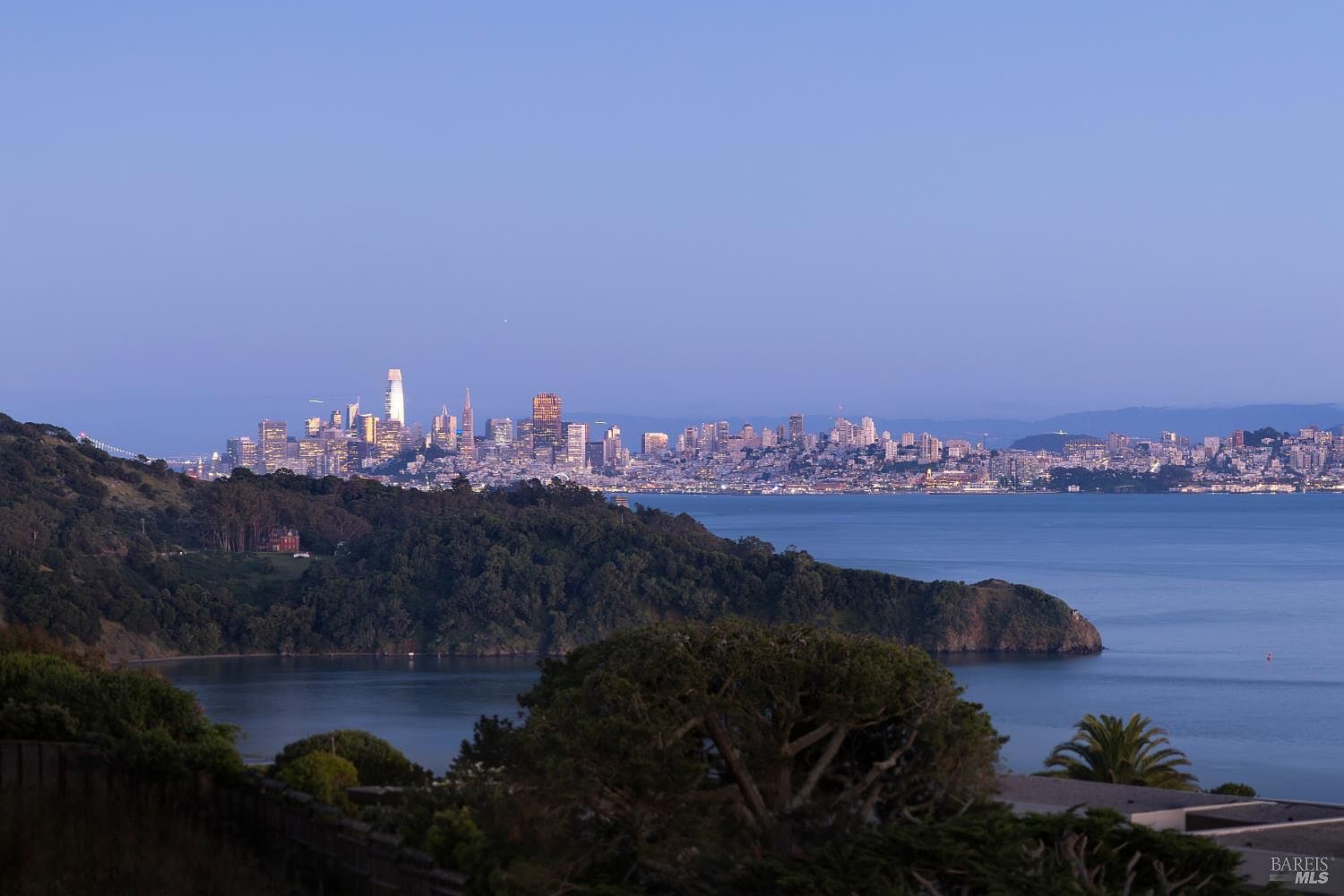
Five NanaWall glass systems, each rising eleven feet, define the character of the interior. When fully opened — and they open completely — the distinction between inside and outside becomes largely philosophical. The Bay air moves through the great room. The sound of the water carries to the kitchen. The light that ignites the eastern hills at dawn moves through the house like a tide, shifting the color of the olivewood paneling from amber to gold as the morning progresses. By afternoon, the water sharpens to a crystalline blue. By dusk, the San Francisco skyline illuminates itself against the darkening sky and the home becomes a quiet theater for one of the world's great urban spectacles.
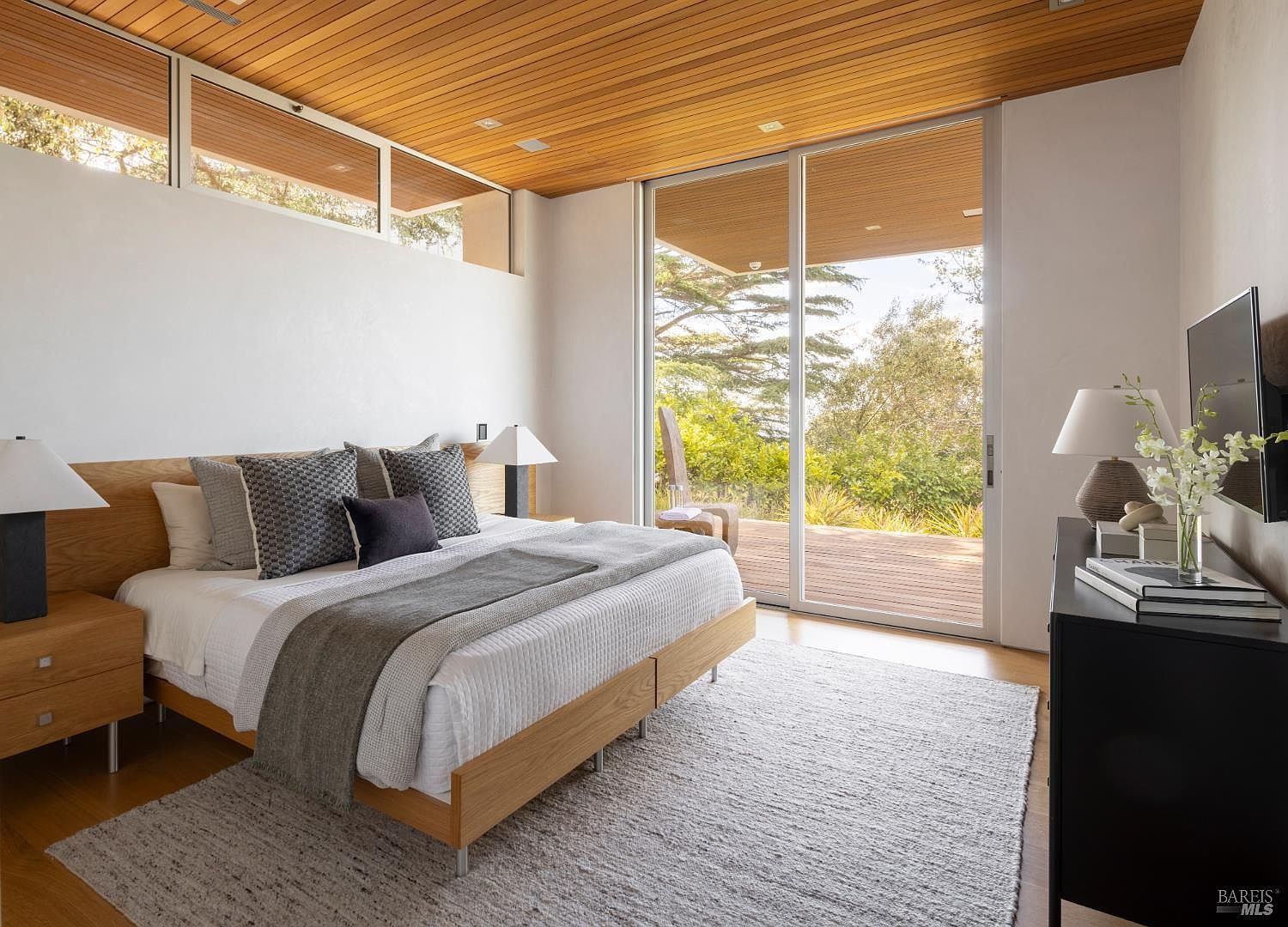
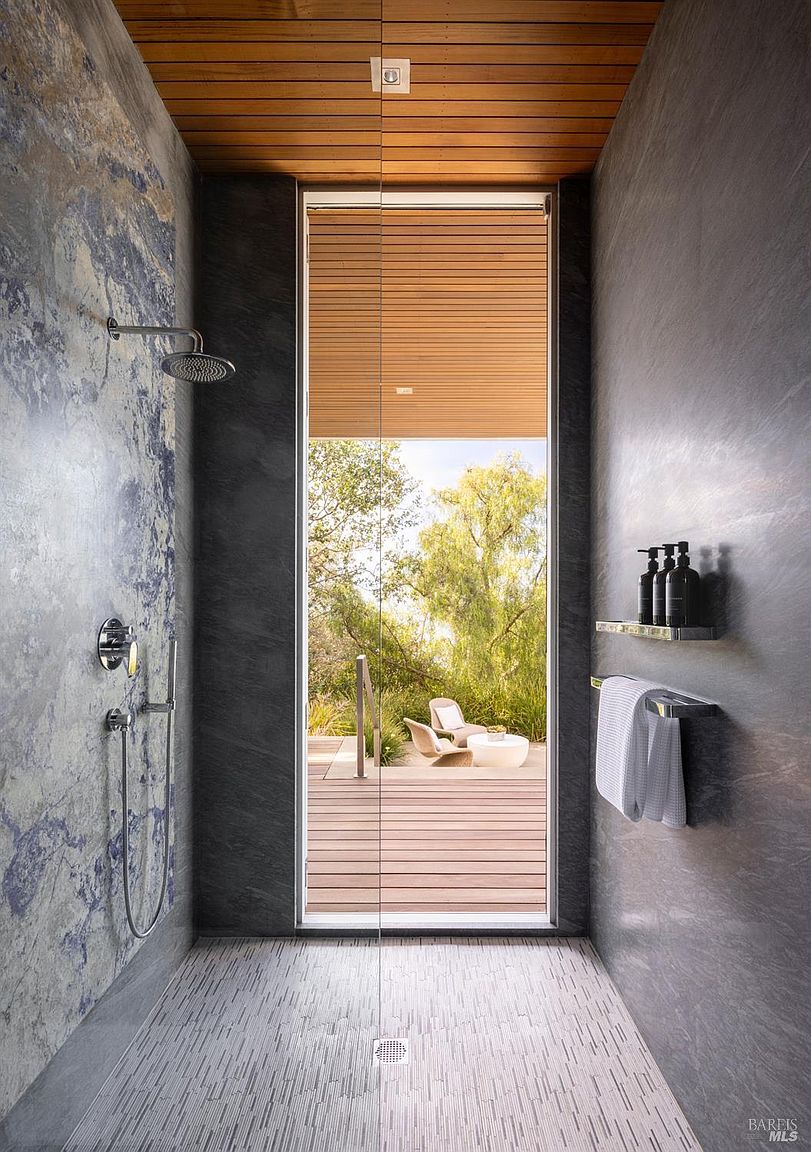
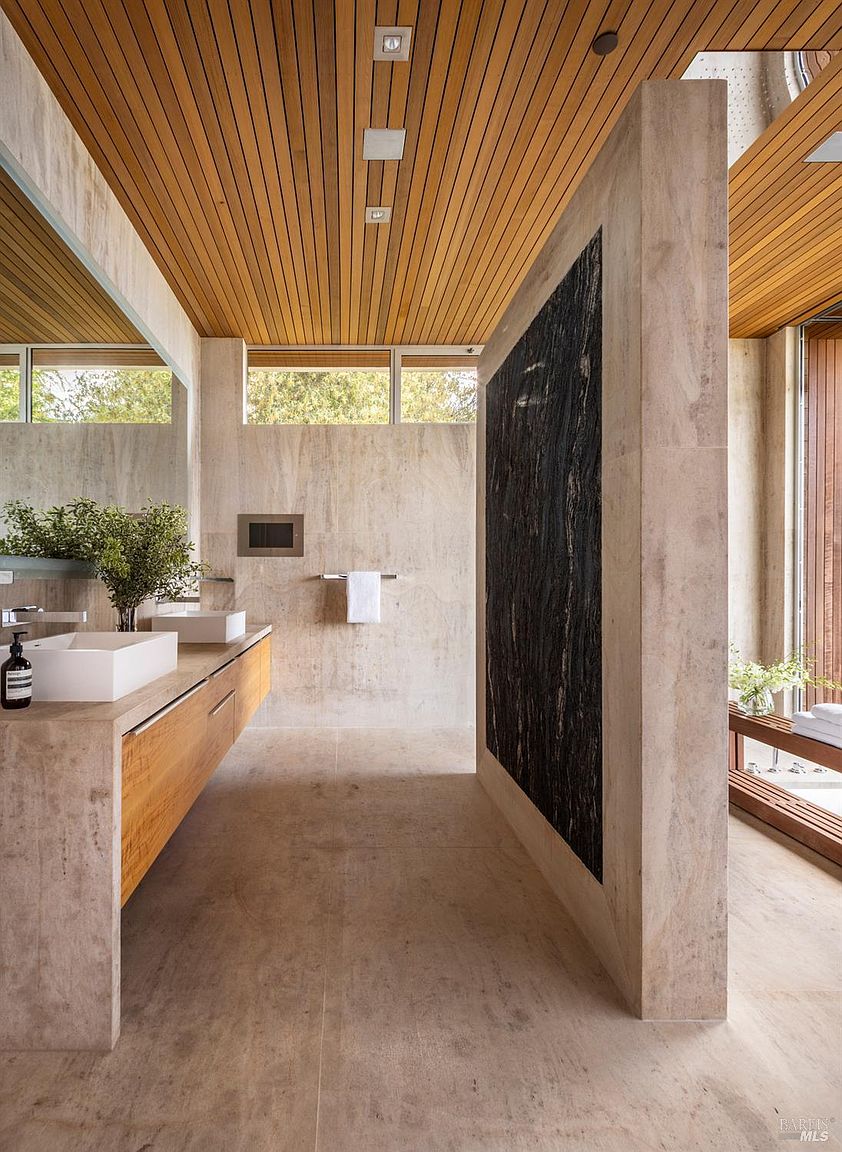
The materials chosen for the interior reflect a seriousness of intention that is immediately legible. Book-matched olivewood paneling lines the walls with the kind of organic symmetry that only nature produces. Pacific red cedar ceilings lend warmth and a faint, grounding fragrance. French limestone and Statuario marble ground the spaces with geological permanence, while Venetian plaster walls carry a depth and luminosity that painted surfaces cannot replicate. At the center of the great room, a floor-to-ceiling glass fireplace serves as both anchor and aperture — a flame visible from multiple sightlines, never interrupting the view beyond it.
The kitchen is designed for serious use and serious occasions in equal measure. Warm wood cabinetry pairs with white surfaces and a full suite of integrated Miele appliances in the primary chef's kitchen, while a dedicated catering kitchen allows large-scale entertaining to proceed without compromising the main space. A floating staircase with glass railings connects both levels with the kind of quiet structural elegance that rewards close attention.
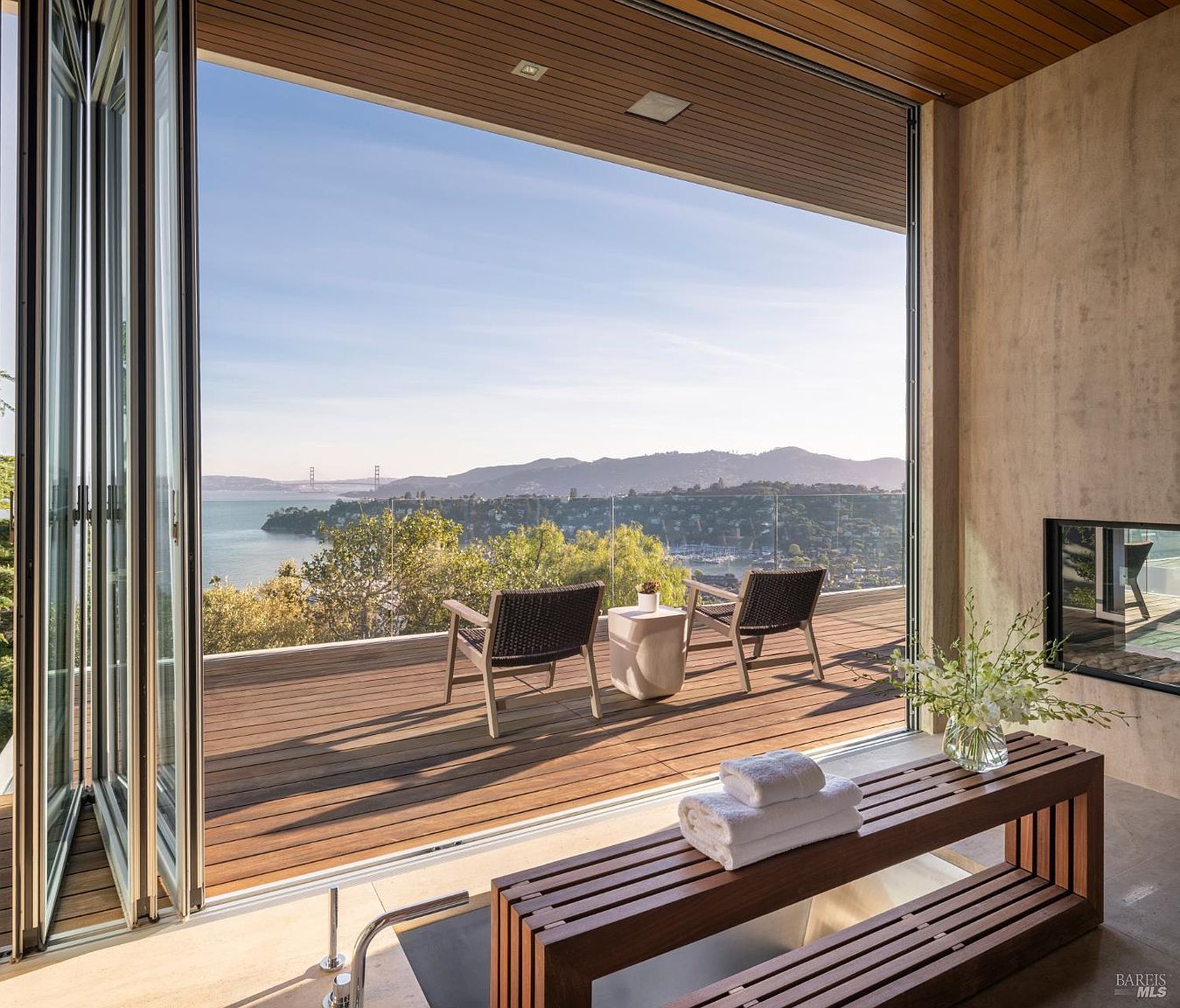
Outside, the grounds are organized as a sequence of distinct outdoor environments. An infinity-edge pool aligns with the southern horizon, creating the visual illusion of water meeting water. Generously proportioned Ipe wood decks extend from the living areas, transitioning to the pool deck and a fully outfitted outdoor kitchen. A level lawn provides a rare and valuable counterpoint to the drama of the hillside setting. Multiple alfresco dining areas ensure that no occasion, from a weeknight dinner to a catered gathering, lacks for the right setting. The primary suite opens directly to the Bay through folding glass doors, with the Golden Gate Bridge framing the horizon at waking. The primary bathroom continues that relationship with the outdoors, its soaking tub positioned beside expansive folding glass panels that open to the deck. Every space in this residence was designed as though the view were a collaborator — because, here, it is.
Tiburon occupies a narrow peninsula that juts into San Francisco Bay from the Marin County shore, and its geography has always determined its character. The name derives from the Spanish word for shark, a reference to the peninsula's pointed shape as seen from the water, and the town has carried a certain sharpness of identity ever since — a place that knows precisely what it is and has little interest in being anything else. What it is, principally, is one of the most quietly distinguished small towns in the Bay Area: a community of roughly nine thousand residents organized around a waterfront Main Street, a working ferry terminal, and a hillside of architecturally considered homes that look out over one of the world's most celebrated bodies of water.
The waterfront itself is the town's social and civic spine. Ark Row, a collection of former houseboats converted into boutique shops, galleries, and cafés, gives Tiburon's commercial district a texture that is genuinely singular in the Bay Area. The town's restaurants line the water's edge, and on clear afternoons — which are frequent, given Tiburon's position in the Bay's microclimate — the outdoor tables fill early with residents who have no particular need to be anywhere else. The Tiburon Ferry connects the town to the Embarcadero in San Francisco in approximately thirty minutes, a commute that is less transportation than ritual: a departure across open water, with the city rising on the horizon as the ferry approaches, and the hills of Marin growing quieter on the return.
Tiburon Ridge Open Space Preserve lies immediately adjacent to the neighborhood, offering miles of trails through native coastal scrub and grassland with views that rival anything the wider Bay Area has to offer. Ring Mountain Open Space Preserve, also nearby, protects one of the last remaining outcroppings of serpentine grassland in Marin County and is home to the Tiburon mariposa lily, a wildflower found nowhere else on earth. These are not incidental amenities. They are the reason residents speak of Tiburon as a place where the quality of daily life is difficult to replicate.
The public schools that serve Tiburon — including Del Mar Middle School and Redwood High School in the Tamalpais Union High School District — have long maintained reputations among the strongest in Marin County and the broader Bay Area, drawing families for whom educational excellence is a foundational consideration. The Reed Union School District, which serves the town's elementary grades, is similarly regarded.
Mill Valley, Sausalito, and Larkspur are each within easy reach by car, bicycle, or foot, extending the range of dining, culture, and commerce available to Tiburon residents without requiring any compromise of the town's own self-contained pleasures. Sausalito's art galleries and waterfront restaurants, Mill Valley's independent bookshops and farmers markets, and Larkspur's ferry terminal and downtown dining scene are all part of the same accessible constellation. What 1860 Mountain View Drive offers, then, is not merely a home of exceptional architectural and material quality. It is entry into a specific and irreplaceable way of life — one organized around water, light, open space, and a community that has understood, for a very long time, exactly what it has.
Featured Highlights
Curated Content • Presented by Joshua Deitch