The Story Behind
AIA Award-Winning Architecture Above the Los Angeles Skyline
There are homes that occupy a site, and there are homes that define it. The residence at 9265 Robin Drive belongs unequivocally to the latter category. Conceived by XTEN Architects — a Los Angeles-based practice renowned for its commitment to site-specific modernism and spatial rigor — and honored with the AIA Los Angeles Award for most influential architecture of 2020, this Bird Streets estate arrives not as a house but as a considered proposition about how architecture can mediate between the human scale and the vast geography of the city below.
The approach announces the home's intentions clearly: a white minimalist facade, disciplined in its restraint, opens to a curved driveway that descends to an eight-car subterranean showcase garage — a feature as much about theater as function. Entry is made through a private courtyard, a deliberate decompression sequence that transitions the visitor from the world outside into an interior universe governed by light, proportion, and material precision.
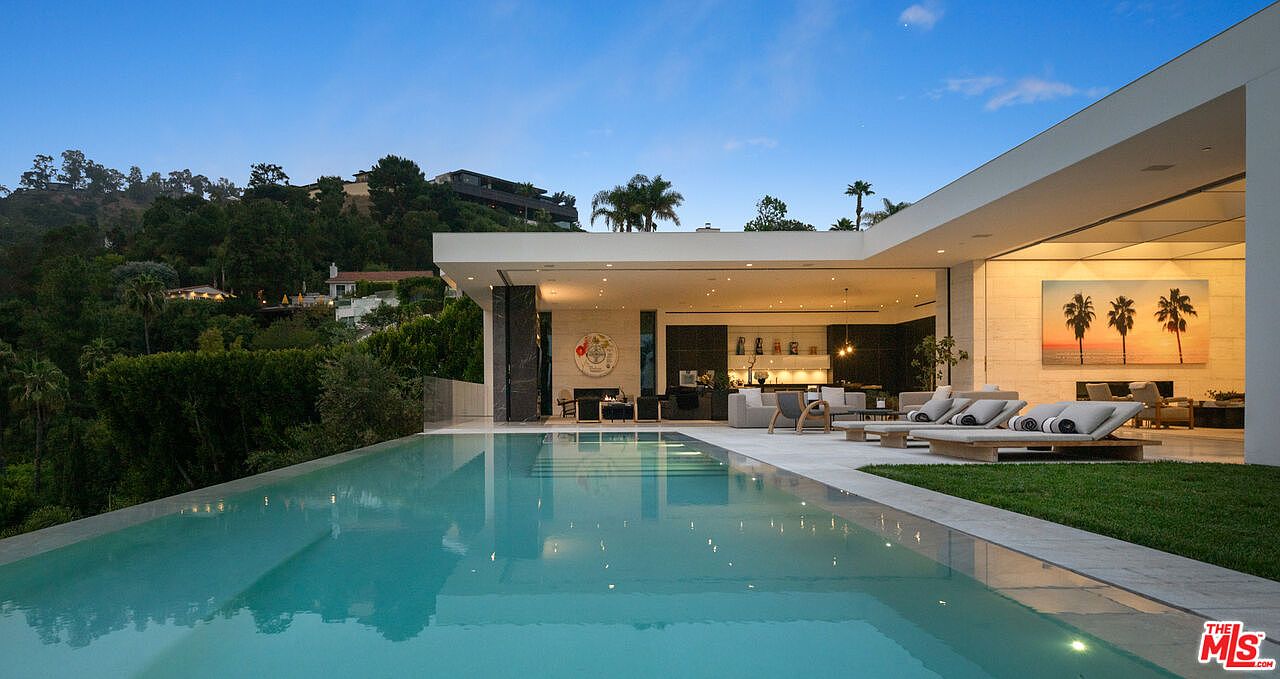
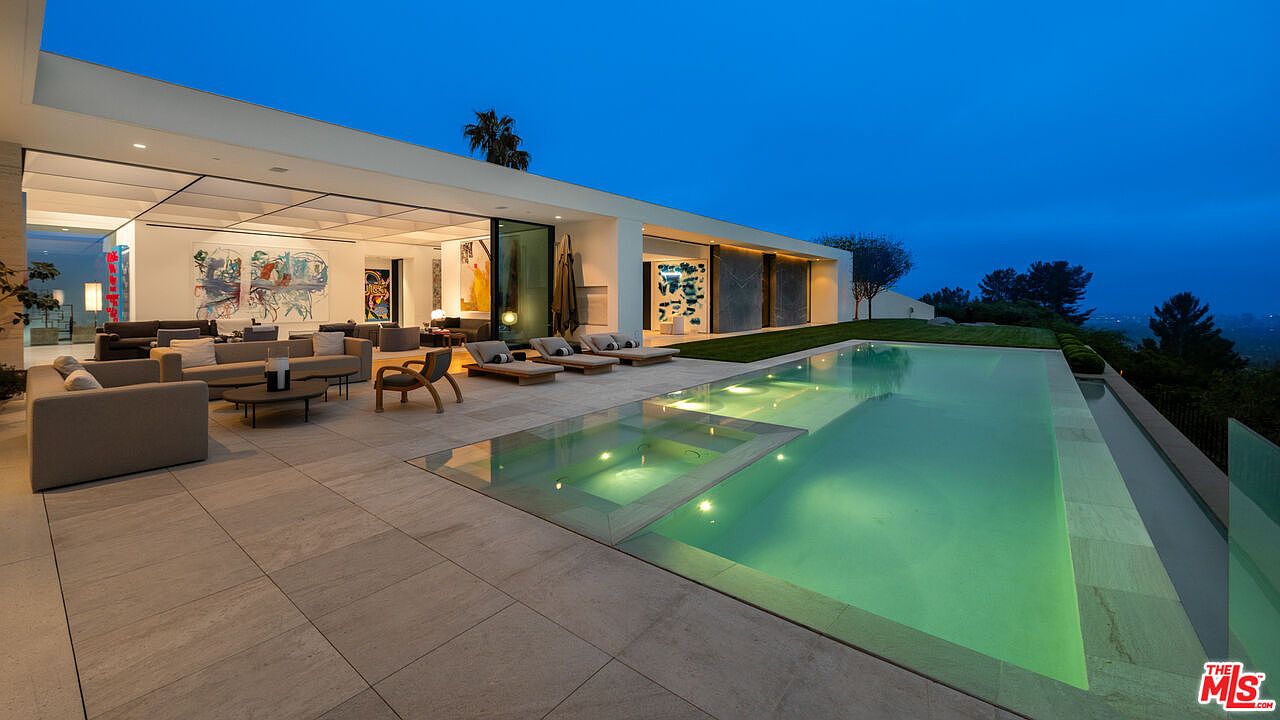
Inside, polished terrazzo floors extend beneath soaring coffered ceilings, their geometry echoing the Kubrick-inspired design philosophy that underpins the entire architectural program. Walls of glass dissolve the boundary between structure and horizon, framing jetliner views that sweep from the city grid to the Pacific with the composure of a curated installation. The great room anchors the social heart of the residence: a large-scale fireplace commands one wall while retractable glass walls open the entire volume to the hillside, collapsing the distinction between inside and out.
The kitchen and family room flow in open-concept continuity — dark charcoal cabinetry set against a light-toned island, high-end appliances, and floor-to-ceiling windows that keep Los Angeles permanently in frame. A floating stone staircase with glass railings moves through gallery-caliber corridors hung with bold contemporary works, each transition an opportunity for the architecture to reassert its gallery-like sensibility.
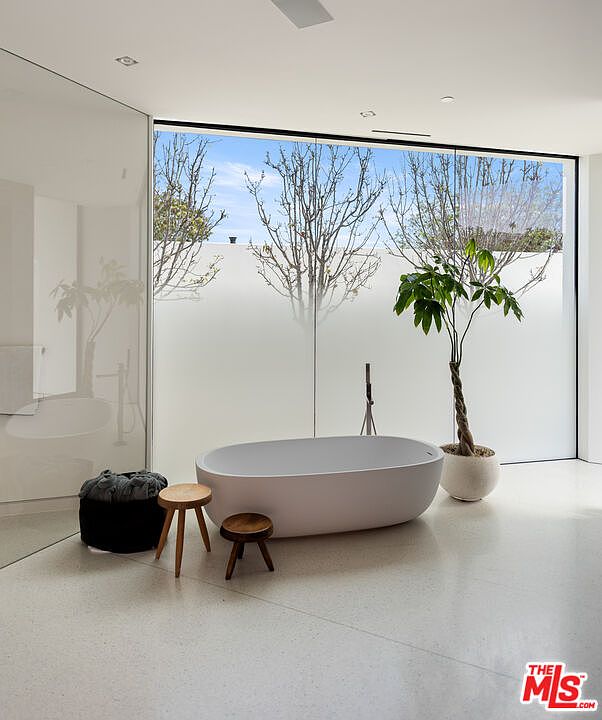
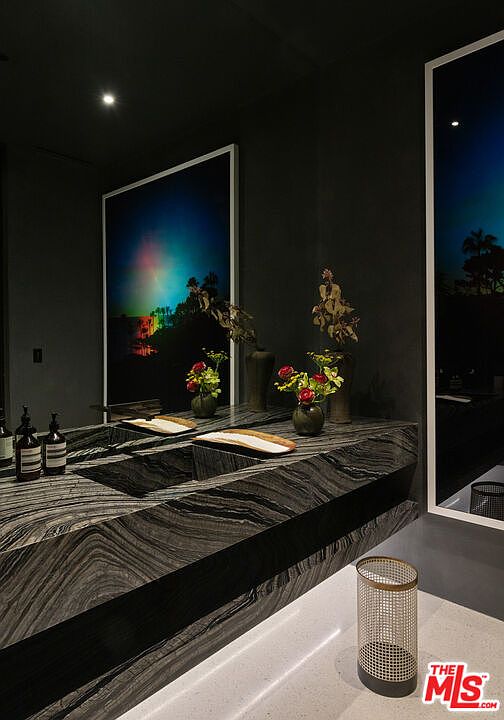
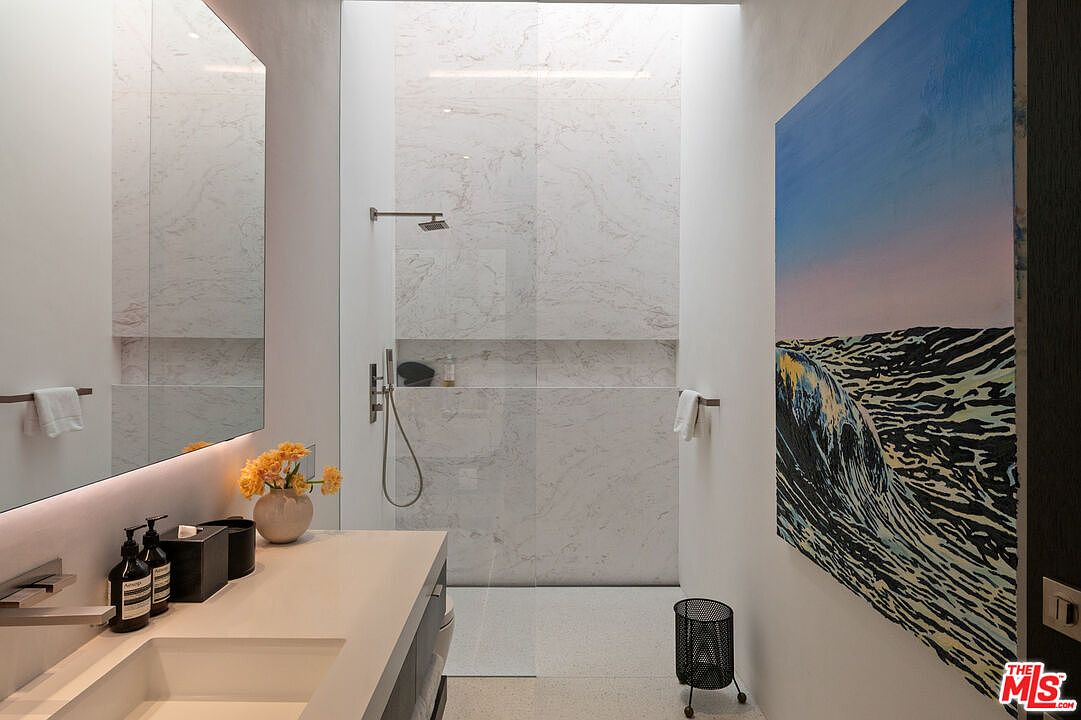
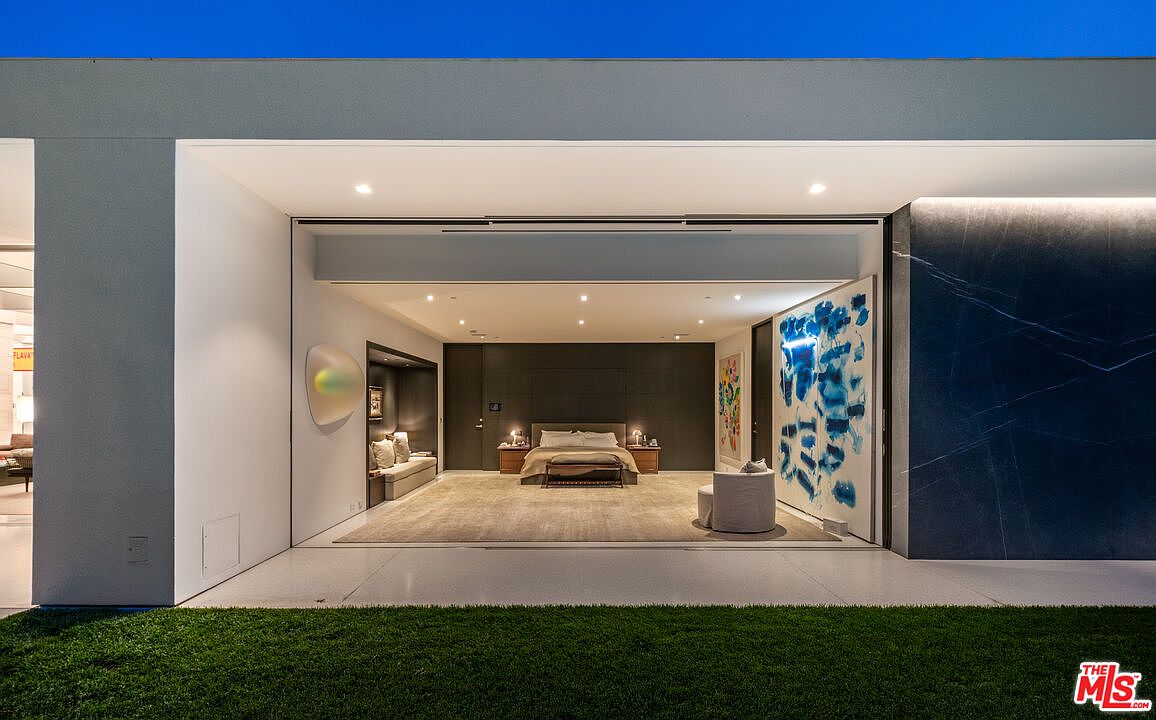
The primary suite is a study in restraint and precision. A dark wood accent wall frames the bed, while floor-to-ceiling sliding glass opens directly to the outdoors, dissolving the threshold between sleep and sky. The spa bathroom is equally considered: a freestanding soaking tub, a steam shower, and a dark marble vanity compose a space that operates with the serenity of a private wellness retreat.
Beyond the primary suite, the interior program extends to a professional theater, a mirrored gym with panoramic hill views, a dedicated dance studio, and a private office — each space resolved with the same architectural seriousness that defines the whole. Outside, the infinity pool and integrated spa sit above a manicured lawn and built-in fire pit terrace, the entire grounds oriented toward the Los Angeles skyline as dusk transforms the city into something luminous and endless. This is architecture with a thesis — and it is impeccably argued.
The Bird Streets occupy a particular place in the mythology of Los Angeles — not simply as a prestigious address, but as a neighborhood that has, over decades, come to embody the city's most enduring aspirations: beauty, privacy, elevation, and the quiet authority that comes from being above it all. Situated in the hills above West Hollywood, the enclave takes its name from the avian designations of its winding roads — Oriole, Nightingale, Thrush, Blue Jay, and Robin among them — streets that curl through the chaparral-covered hillsides of the Hollywood Hills West in a manner that feels, by design or happy accident, almost entirely removed from the city that pulses below.
The neighborhood's position between Laurel Canyon to the east and the Sunset Strip to the south places it at a genuinely privileged intersection of Los Angeles geography. Laurel Canyon carries with it a storied cultural history — the creative enclave that shaped the sound of American music in the late 1960s and 1970s, and which has retained an artistic character that distinguishes the broader hillside community from more conventional luxury neighborhoods. The Sunset Strip, meanwhile, remains one of the most culturally and commercially vital corridors in the city, home to landmark hotels including the Chateau Marmont and the Sunset Tower, as well as a concentration of restaurants, galleries, and venues that draw from across the metropolitan area.
The Bird Streets themselves have long attracted residents who place a premium on discretion and architectural distinction in equal measure. The neighborhood's cul-de-sacs and limited-access roads create a natural buffer from the commercial energy of the Strip below, while the hillside topography ensures that virtually every property commands meaningful views — a rarity in a city where the view premium is among the most fiercely competed real estate variables.
Day-to-day life in the Bird Streets is organized around the particular rhythms of elevated hillside living. The proximity to West Hollywood places world-class dining, retail, and wellness within minutes: Melrose Avenue, Robertson Boulevard, and the Design District are all easily accessible, as are the hiking trails of Runyon Canyon Park, which offers some of the most dramatically situated open space in urban Los Angeles. The canyon's trails provide direct access to sweeping city views and a natural landscape that feels genuinely wild against the backdrop of the metropolis.
For residents whose lives extend across the broader Los Angeles region, the Bird Streets offer efficient access to Beverly Hills, Century City, and the Westside, while remaining meaningfully insulated from the congestion of the flatlands. The neighborhood's concentration of architecturally significant residences — many designed by prominent local and international practices — has created a community with an unusually coherent aesthetic identity, one in which considered design is not the exception but the prevailing standard.
To live here is to occupy a position that is simultaneously central to and elevated above the full spectacle of Los Angeles — a vantage point that the city's most discerning residents have sought, and rarely relinquished, for generations.
Featured Highlights
Curated Content • Presented by Kurt Rappaport