The Story Behind
Downtown Manhattan's Most Extraordinary Penthouse Loft Reimagined
There are penthouses, and then there is 383 West Broadway. To step off the private elevator into the wood-paneled entry is to understand immediately that what lies ahead operates by an entirely different set of rules. The boutique building's mere nine residences ensure a level of discretion rarely encountered in Manhattan, and the home's designers — Piero Manara and Debla Manara-Berger of the celebrated atelier Casamanara — have honored that privacy with architecture that feels at once monumental and deeply personal.
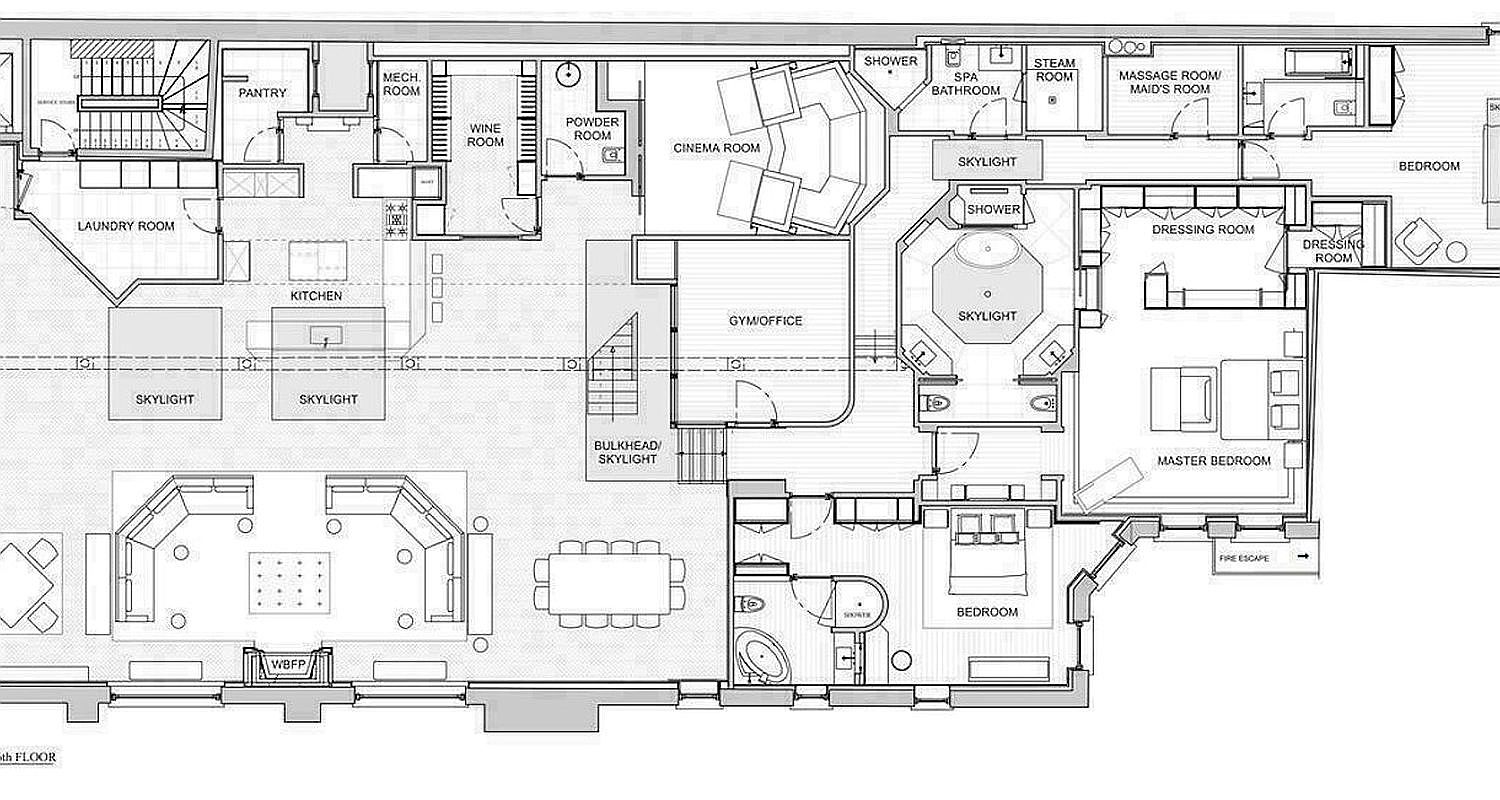
The living room, measuring sixty-five by forty feet, is the kind of space that recalibrates one's understanding of scale. Original cast-iron columns, up-lit to command the full drama of their industrial heritage, rise toward ceilings that climb from sixteen to twenty-two feet, punctuated by skylights that distribute daylight with curatorial precision. Massive south- and west-facing windows frame the Freedom Tower as though it were a living artwork, while a nearly six-foot wood-burning fireplace — finished in polished Eramosa marble with a honed Cohare marble hearth — anchors the room with quiet authority. Herringbone white oak floors and Venetian plaster walls in soft white extend throughout, providing a refined canvas against which every considered detail registers.
The Bulthaup kitchen, rendered in grey aluminum with Carrara marble counters and a custom-built marble sink, is a study in restrained luxury. Gaggenau, Sub-Zero, and Miele appliances — including a built-in coffee maker and instant-hot and filtered water — ensure that the kitchen performs as fluently as it presents.
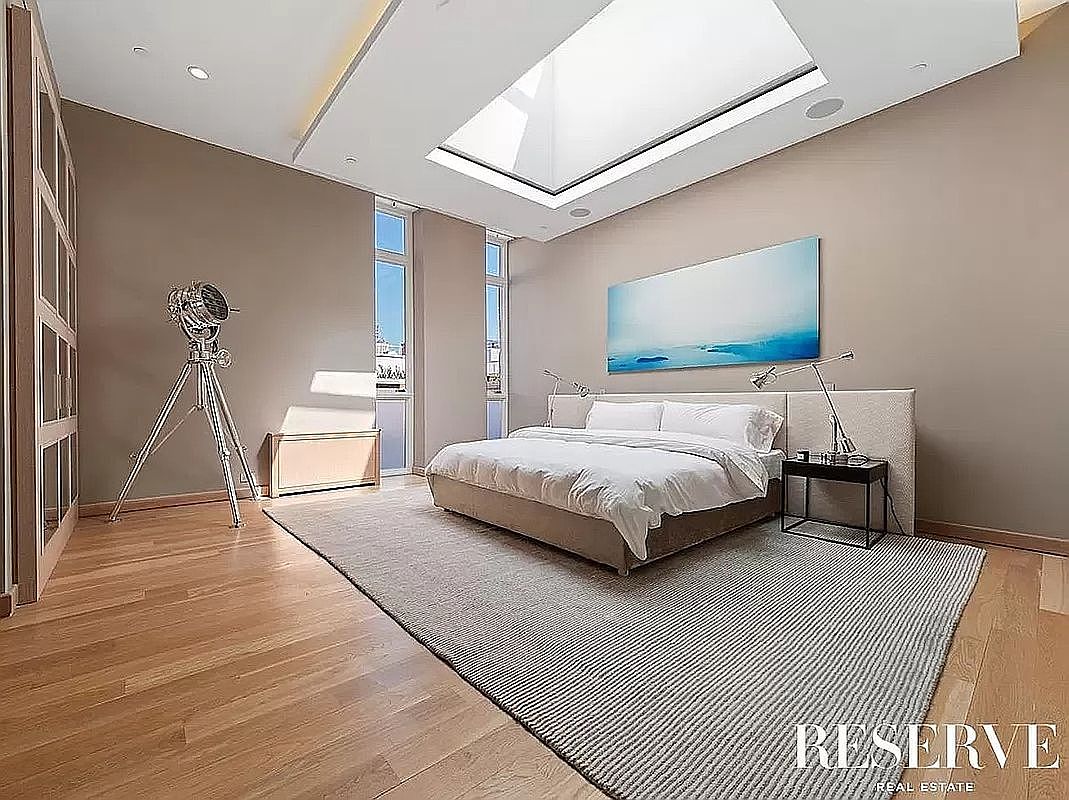
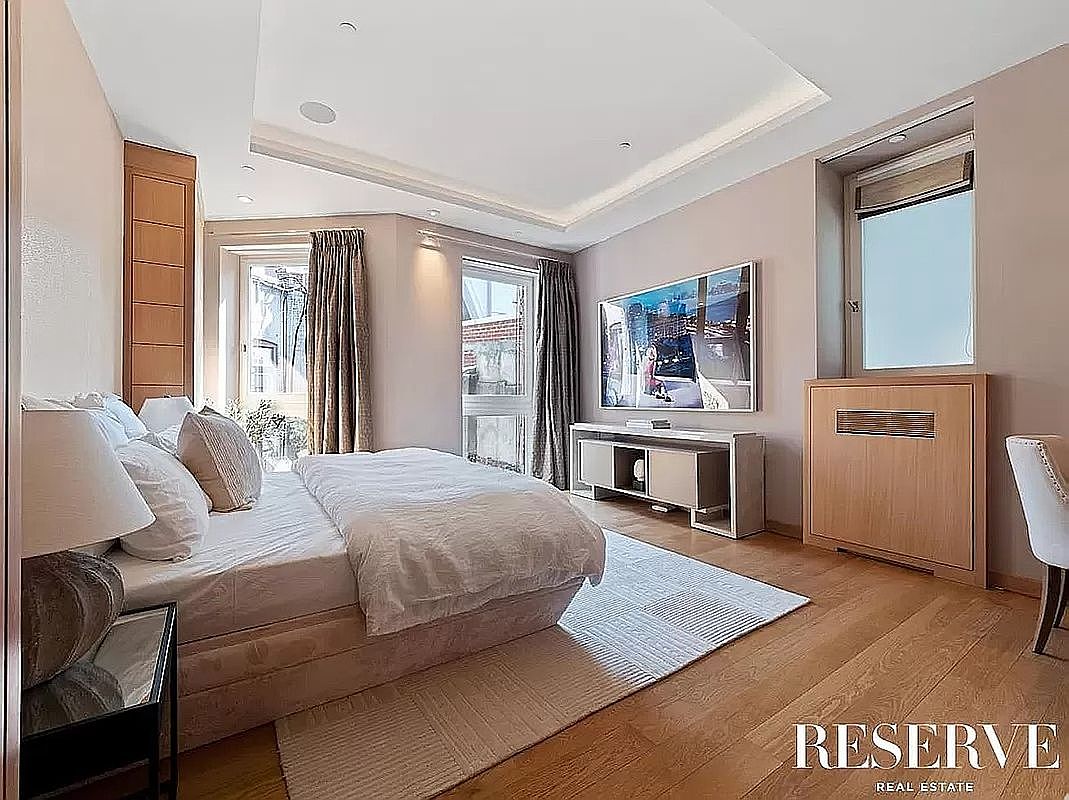
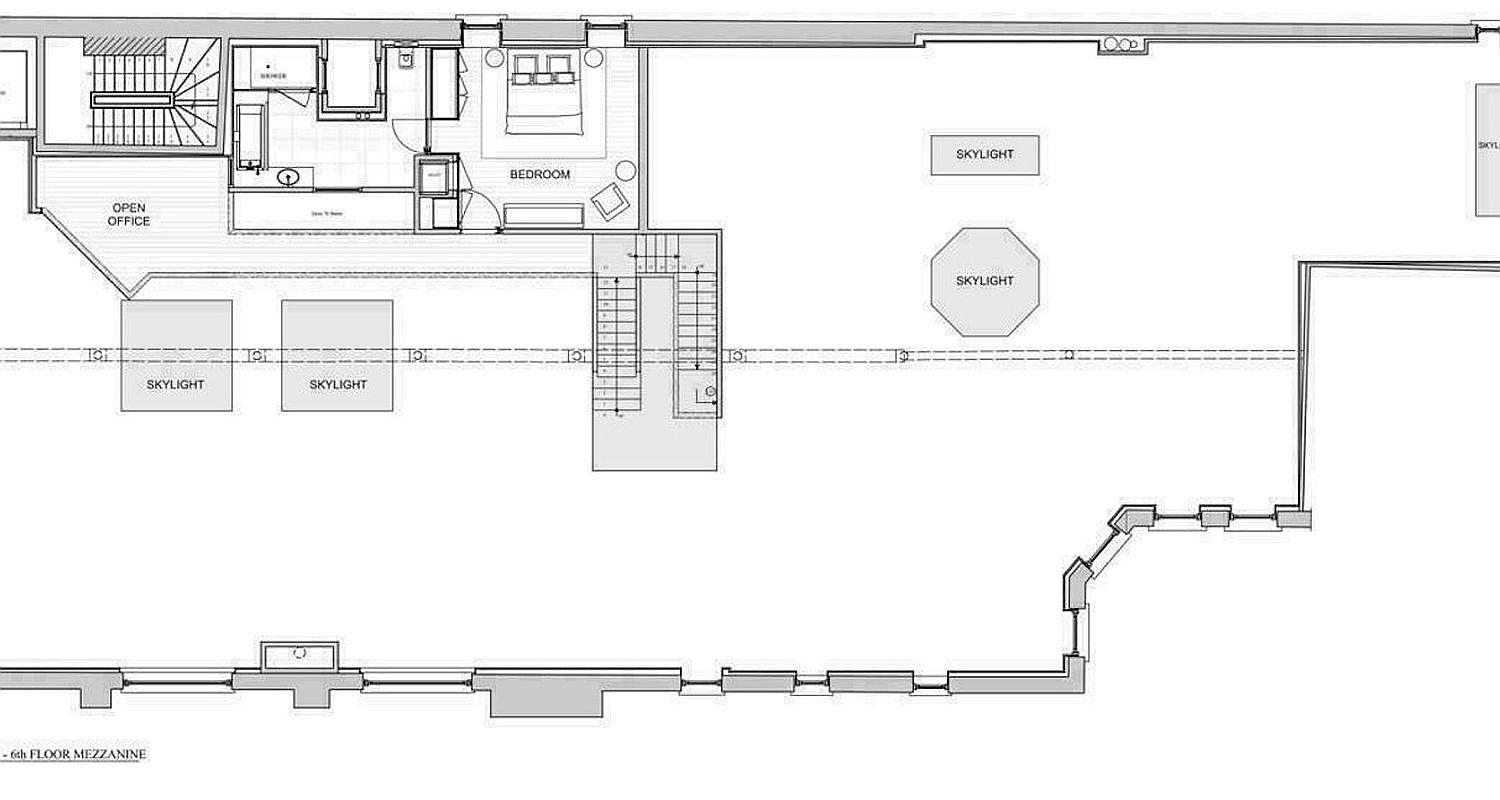
The primary suite is its own architecture. Silk carpeting, a custom-milled white oak walk-in closet and vault, and an ensuite bathroom defined by a soaring octagonal skylight set the tone. Book-matched Gaudi slab marble floors, a freestanding Oceanus soaking tub by Tyrell and Laing, and a white onyx-lined double shower room with rain-head delivery complete a bathroom that rivals the finest urban spas.
Elsewhere, the home reveals its ambitions with equal conviction. A Dolby 10.1 surround-sound media room with plush stadium seating, ultra-suede lined walls and ceilings, and a large projection screen sits adjacent to a glass-encased, climate-controlled 1,500-bottle wine cellar with a dedicated Sub-Zero refrigerator for wine and champagne. A home gym and yoga studio open to a private massage room and a six-person steam room with Kohler aromatherapy and chromatherapy delivered through a 100-head fiber-optic lighting system integrated into a mosaic-tiled barrel ceiling.
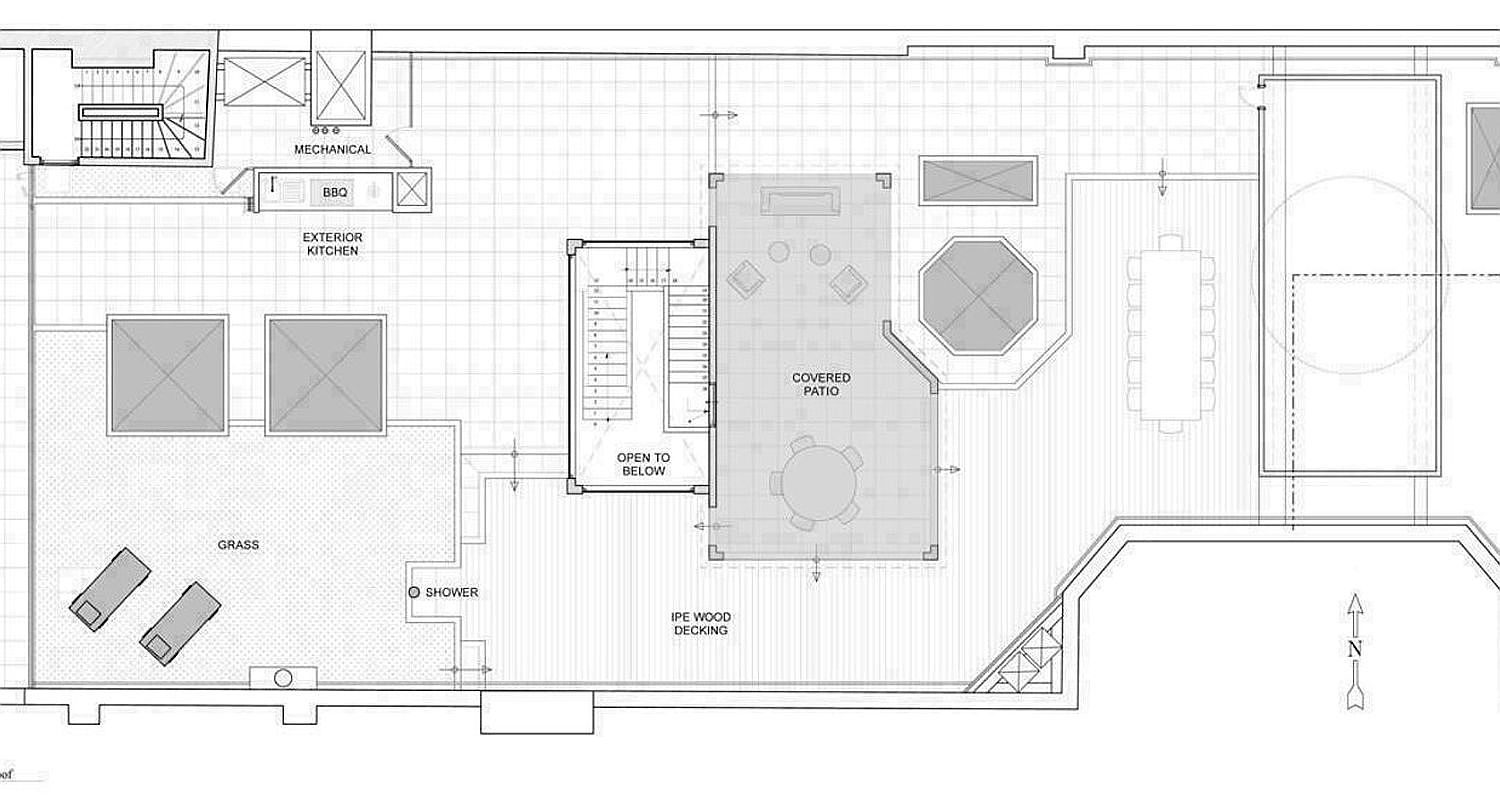
Above it all, a thirty-foot glass-peaked bulkhead houses the illuminated stairwell ascending to the mezzanine library and fourth bedroom, then continues to the rooftop — 4,200 square feet of wood decking, pavers, simulated lawn, Balinese stone and copper-clad walls, a fully equipped outdoor kitchen, and a Boffi outdoor shower. The Empire State Building and the Freedom Tower, visible simultaneously, stand as the terrace's permanent backdrop. Lutron lighting, a Savant AV system, and motorized shades controlled via wall-mounted iPads govern the home's systems with seamless intelligence. This is not merely a penthouse. It is a permanent installation in the most meaningful sense.
SoHo — an acronym for South of Houston Street — occupies a singular position in the cultural geography of New York City. Originally developed as a dense manufacturing district in the mid-nineteenth century, the neighborhood's cast-iron industrial buildings were, by the 1960s and 1970s, being quietly colonized by artists drawn to their vast, light-flooded floor plates and affordable rents. That migration gave rise to one of the most consequential artistic communities in American history, and the neighborhood's identity as a creative capital has never fully departed, even as SoHo evolved into one of the most coveted addresses in the world.
The cast-iron architecture that defines SoHo's streetscape — recognized by the SoHo-Cast Iron Historic District, a designation that encompasses the largest concentration of cast-iron architecture anywhere in the world — lends the neighborhood a visual coherence and historical weight that newer developments simply cannot replicate. Walking its cobblestone streets, lined with ornate facades that date to the 1860s and 1880s, carries the particular satisfaction of inhabiting a living landmark.
383 West Broadway sits on one of SoHo's most distinguished blocks, a stretch that has long attracted the neighborhood's most discerning residents and institutions. The building's address places it at the intersection of the neighborhood's commercial and residential finest: world-class galleries, celebrated restaurants, and flagship boutiques are all within easy walking distance. Spring Street, Prince Street, and West Broadway itself have long served as the neighborhood's primary cultural and retail corridors, hosting a roster of international fashion houses, independent design studios, and art spaces that give SoHo its continued relevance on the global stage.
The culinary landscape surrounding the property is equally distinguished. SoHo and its immediate neighbors — Tribeca to the south, NoLita to the east, and the West Village a short walk to the north — collectively comprise one of the most celebrated dining destinations in the city, with options ranging from neighborhood institutions to Michelin-recognized destinations.
For those who value connectivity, SoHo's positioning is exceptional. Multiple subway lines serve the neighborhood, providing direct access to Midtown, the Financial District, and beyond. The Hudson River Park greenway is easily reachable, offering miles of waterfront cycling and recreation. The High Line, Washington Square Park, and the Whitney Museum of American Art are all within comfortable reach, ensuring that the full breadth of Manhattan's cultural and recreational life remains close at hand.
Perhaps most significantly, SoHo offers something increasingly rare in Manhattan: a genuine sense of neighborhood identity. The low-rise scale of its protected historic district, the rhythm of its gallery openings and weekend street life, and the enduring presence of the creative community that first established its character all conspire to create a place that feels both cosmopolitan and intimately human. For a residence of this penthouse's stature — one that demands a setting equal to its own ambitions — SoHo remains the only address that fully answers.
Featured Highlights
Curated Content • Presented by Trish Riedel