The Story Behind
A Century of Grandeur on Seattle's Most Coveted Street
There are homes that shelter, and there are homes that endure — structures that accumulate meaning with each passing decade until they become inseparable from the city itself. 1625 Federal Avenue East is unmistakably the latter. Commissioned in 1924 and conceived by Edwin Ivey, one of Seattle's most distinguished architects of the early twentieth century, this Mediterranean Revival estate was built at a moment when Capitol Hill's grandest families were staking their claim on the heights above Lake Union, and it has presided over the neighborhood with quiet authority ever since.
The approach alone signals what awaits. Ornate iron gates open onto a patterned brick motor court framed by mature specimen trees, their canopies arching overhead to create a sense of arrival that few urban properties can match. The stucco facade, with its dark shutters, arched garage doors, and decorative balcony, reads as both deeply rooted and effortlessly timeless — a composition that owes as much to the hillside villas of the Italian Riviera as it does to Seattle's own Craftsman-inflected sensibility.
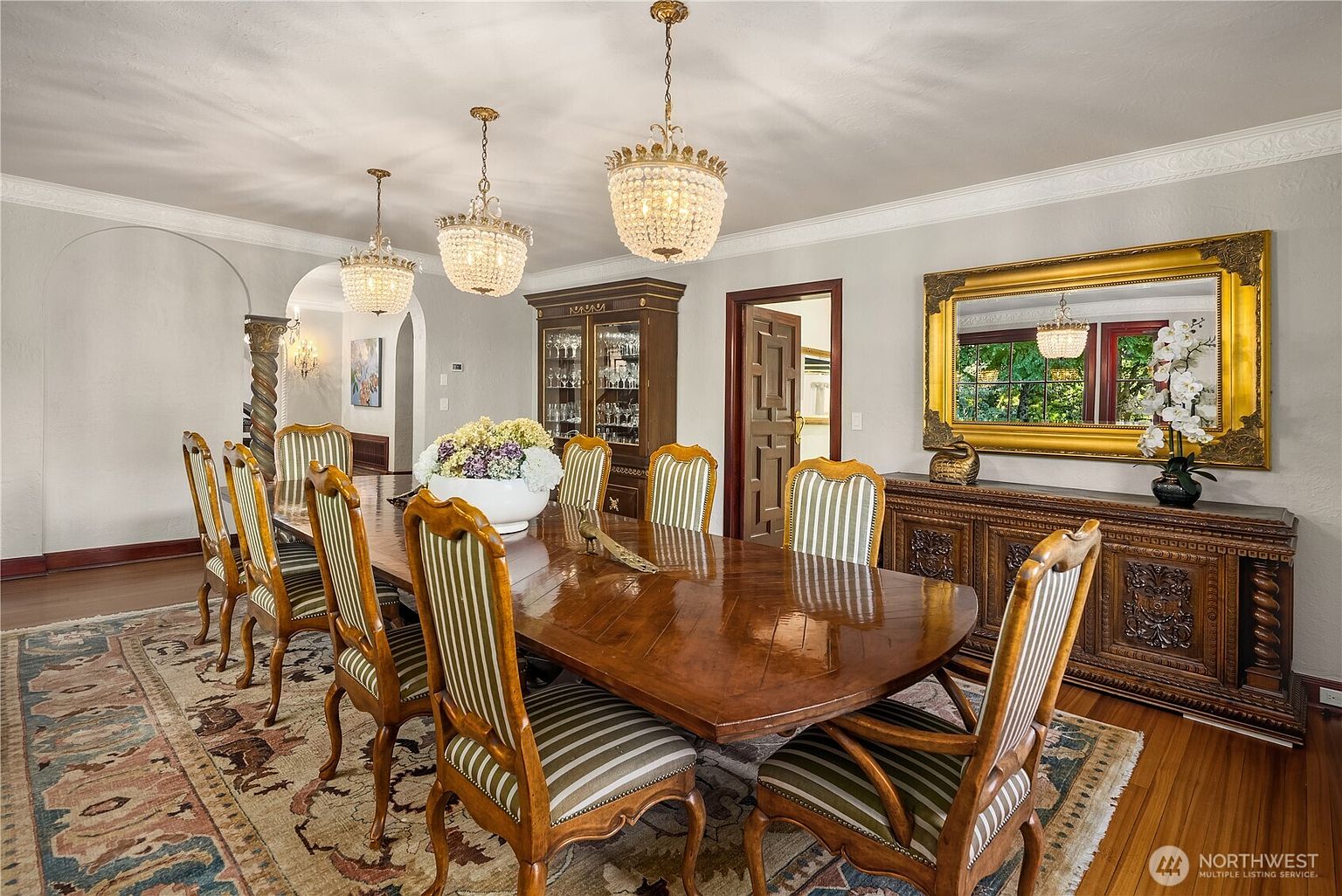
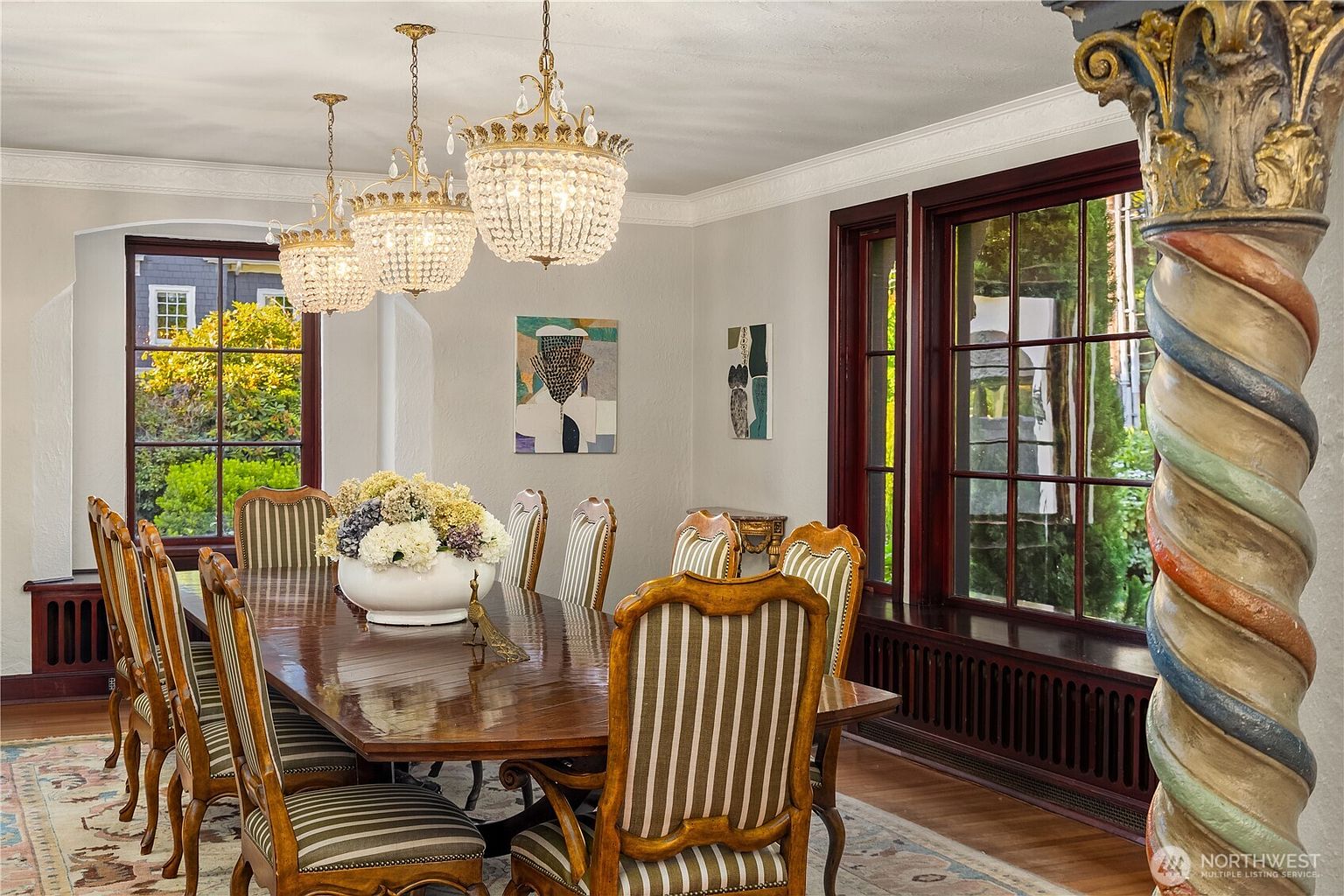
Step through the front door and the scale of the home announces itself immediately. A mosaic tile foyer — its floor a kaleidoscope of hand-laid pattern — draws the eye upward to a sweeping curved staircase and a cascading crystal chandelier suspended from an ornate ceiling medallion. From this threshold, arched openings framed by stone columns establish the architectural grammar that flows throughout: grandeur earned through proportion, not excess.
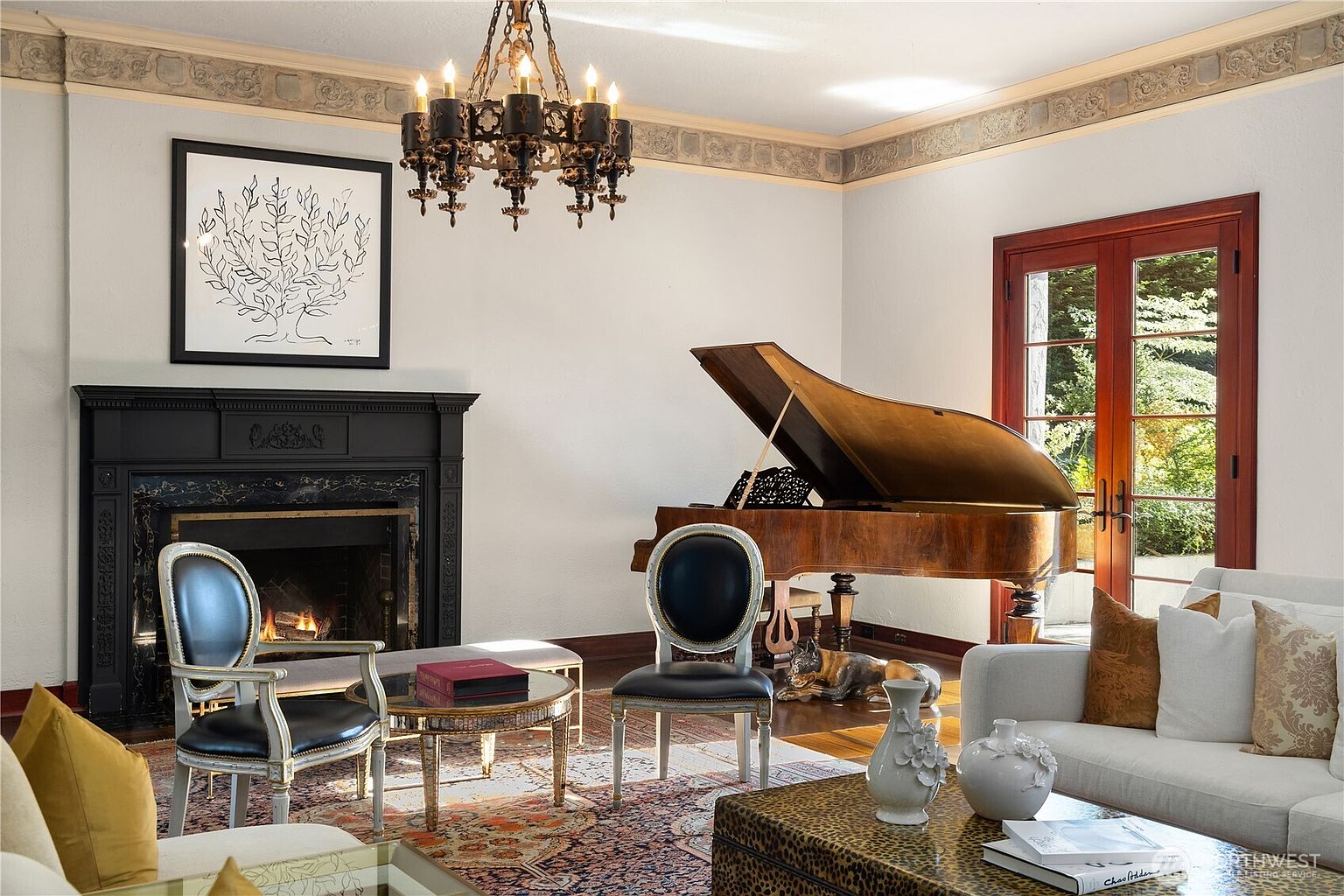
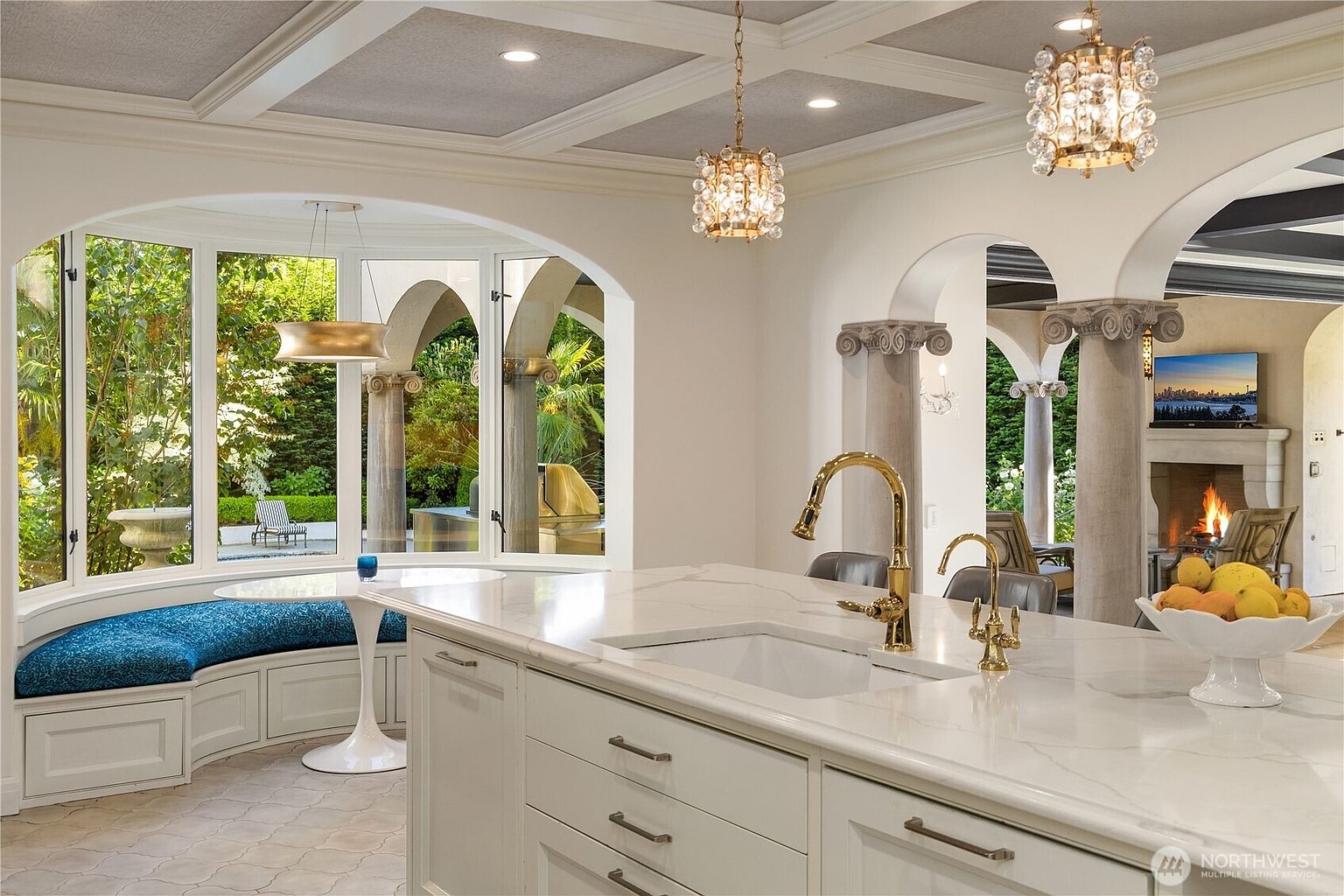
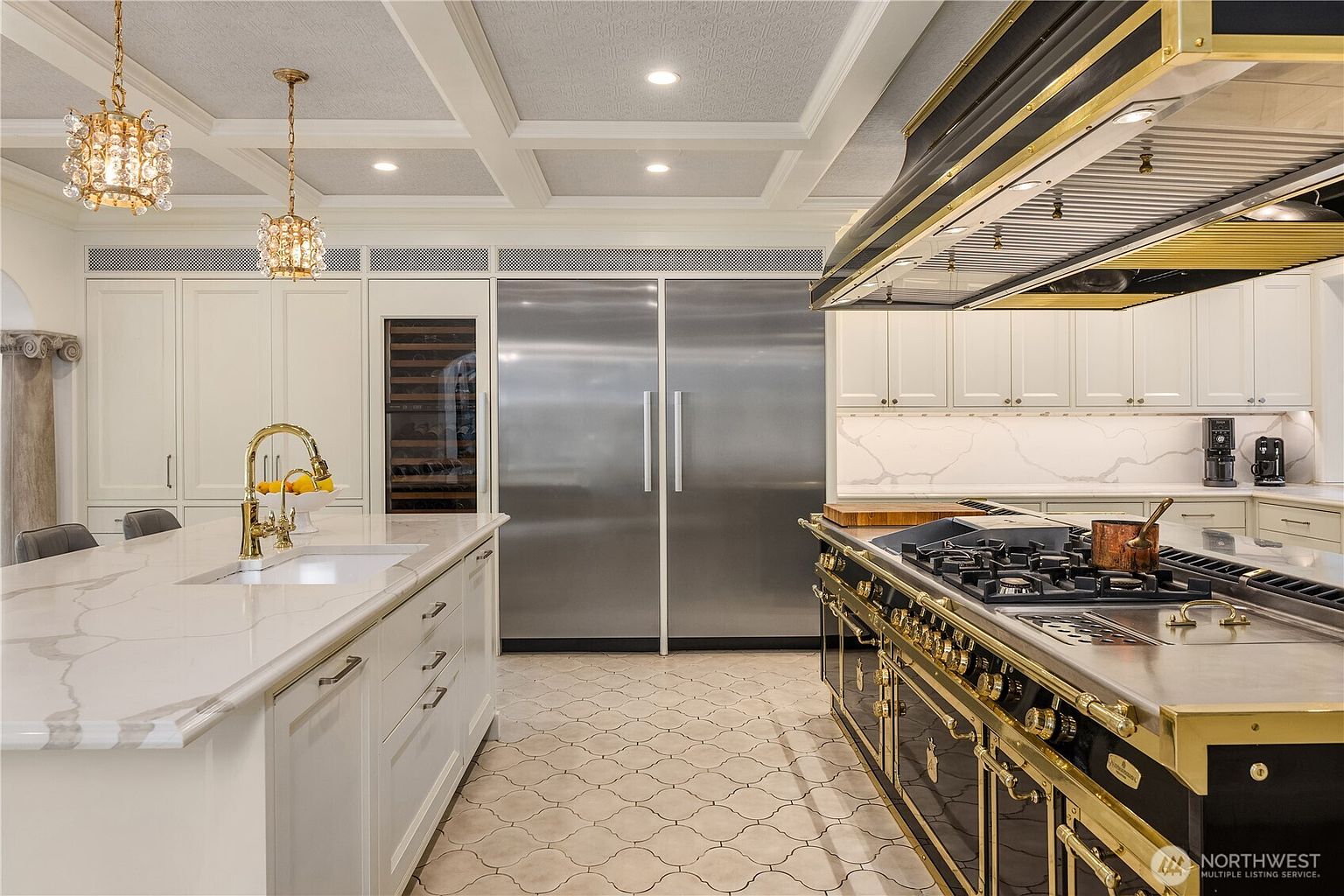
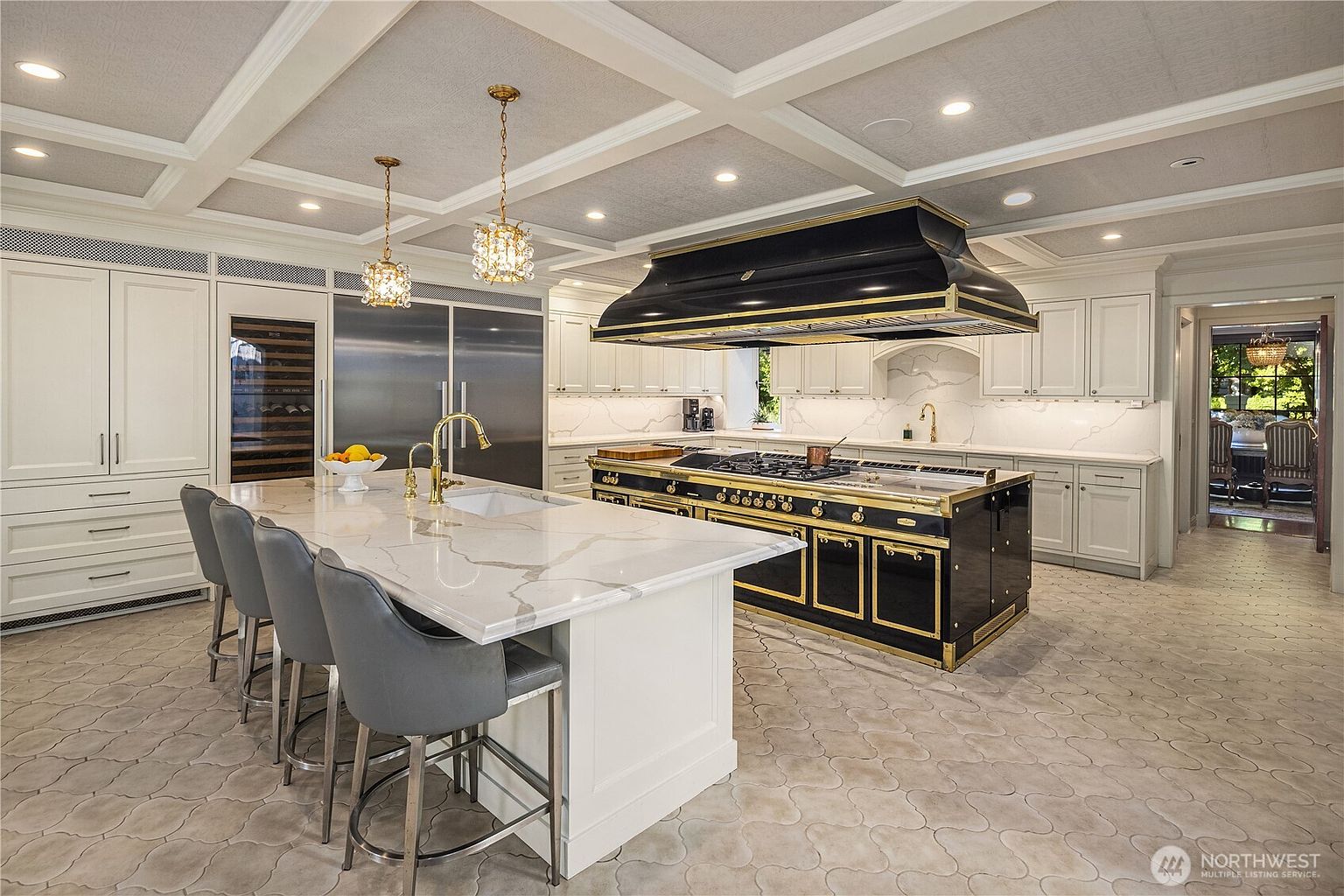
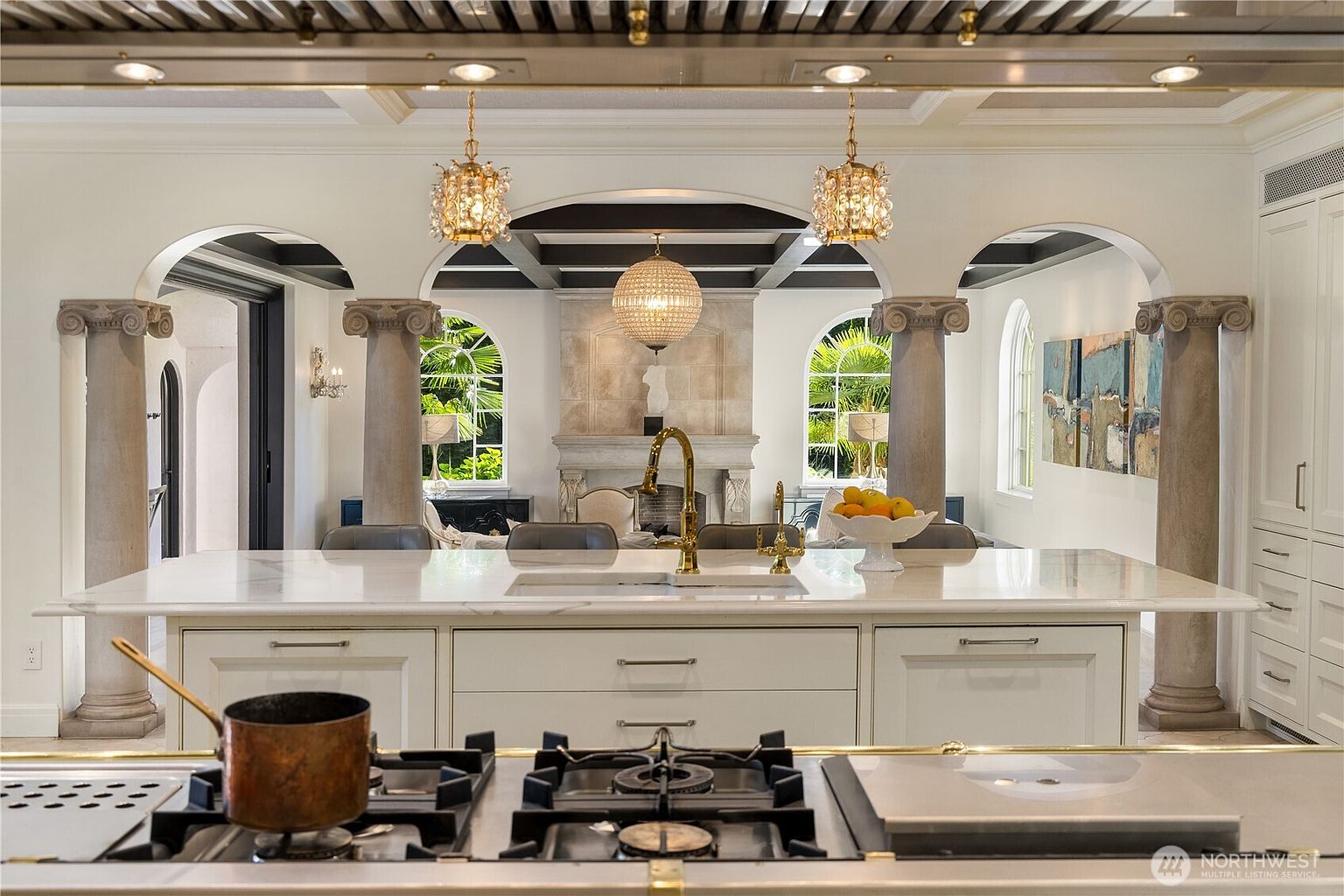
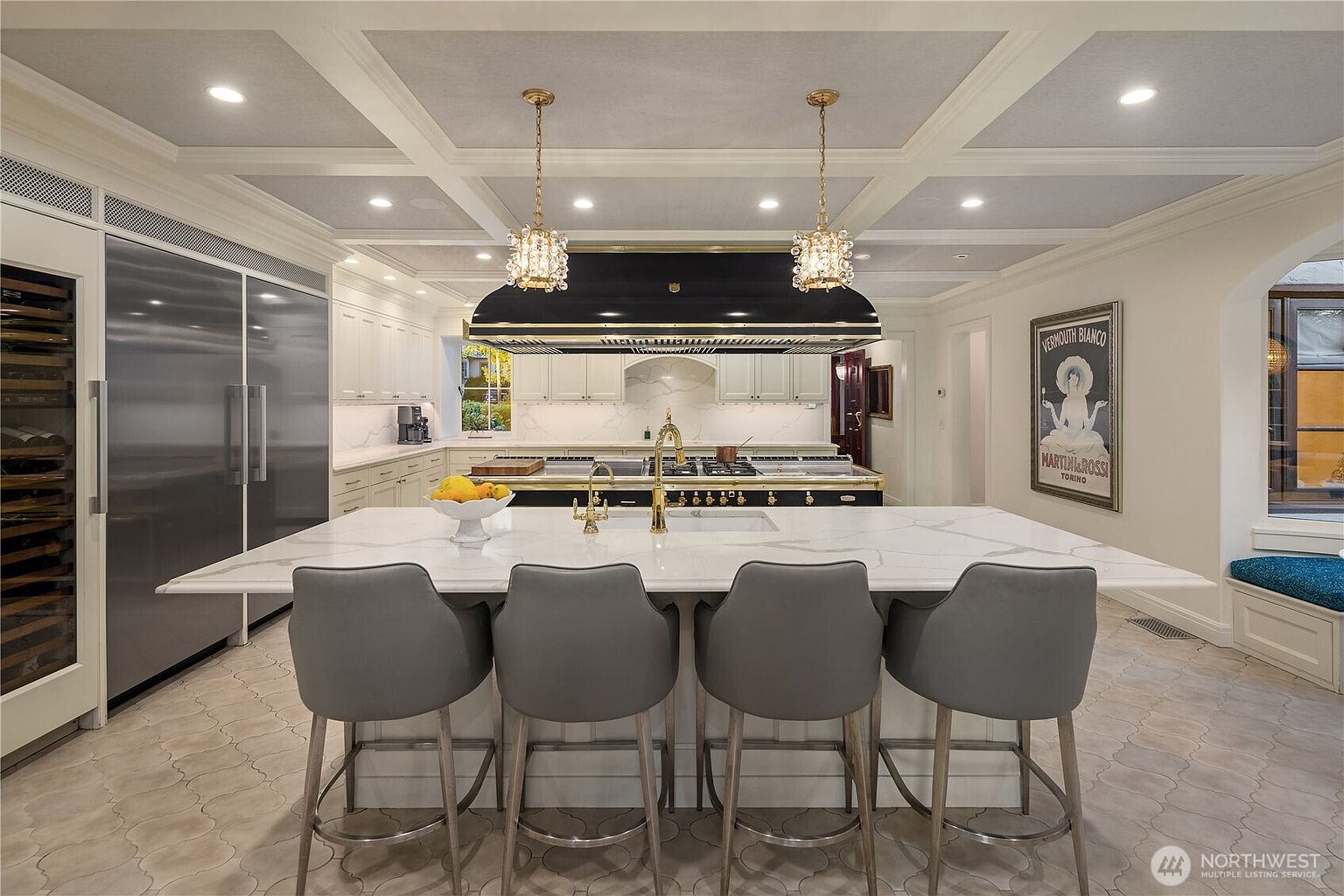
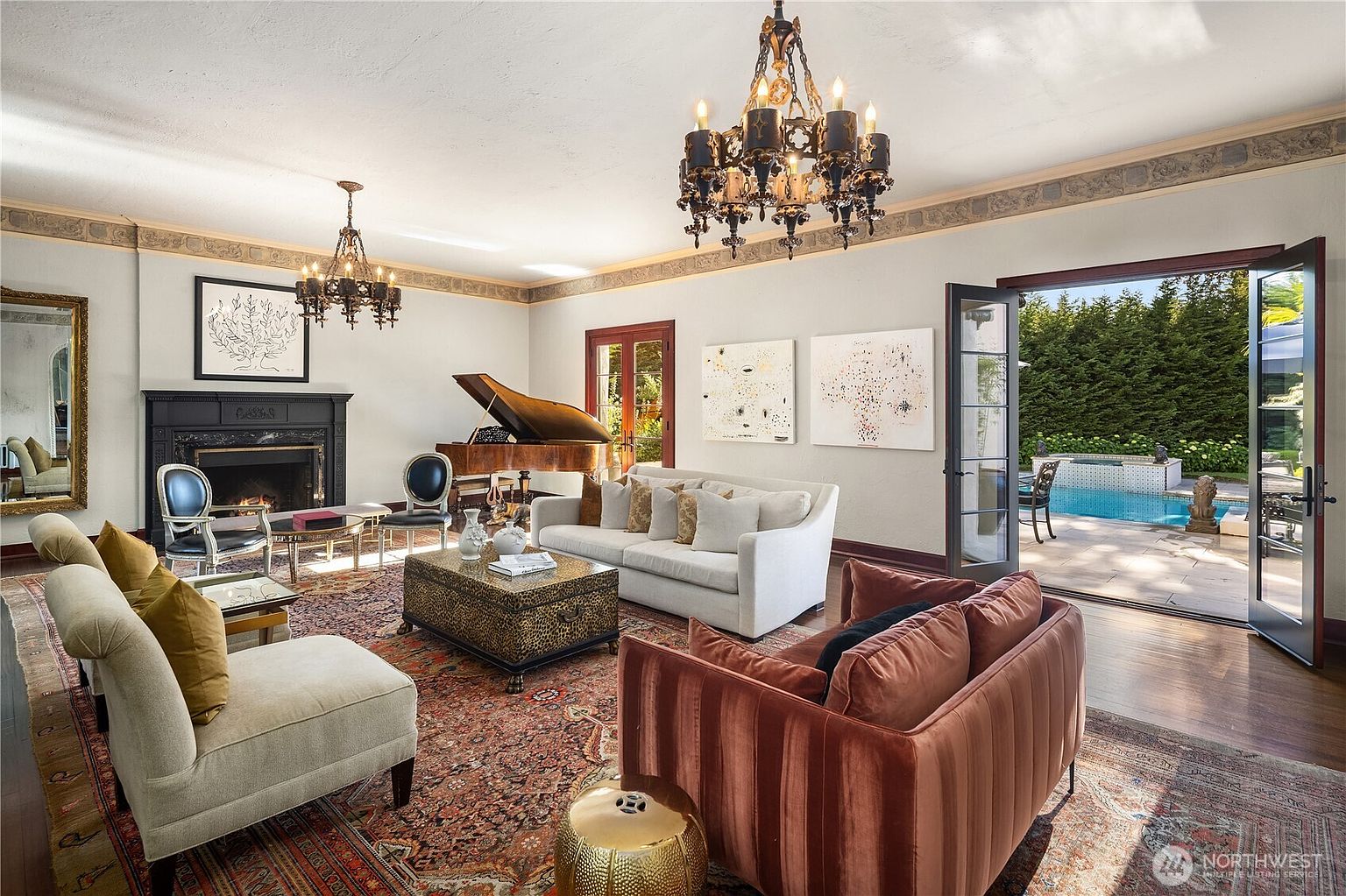
The great room commands attention with its coffered ceiling of dark timber beams, its arched windows framing views of lush greenery, and a stone-clad fireplace of considerable presence. The kitchen is a study in the art of the purposeful splurge. At its center, a bespoke Officine Gullo cooking island — the Florentine manufacturer's signature black-and-brass professional range paired with a monumental matching hood — anchors a space defined by stone-topped islands, intricate patterned tile flooring, crystal pendant lighting, and a curved breakfast nook nestled beneath garden-facing windows. It is a kitchen that invites both the serious cook and the effortless entertainer.
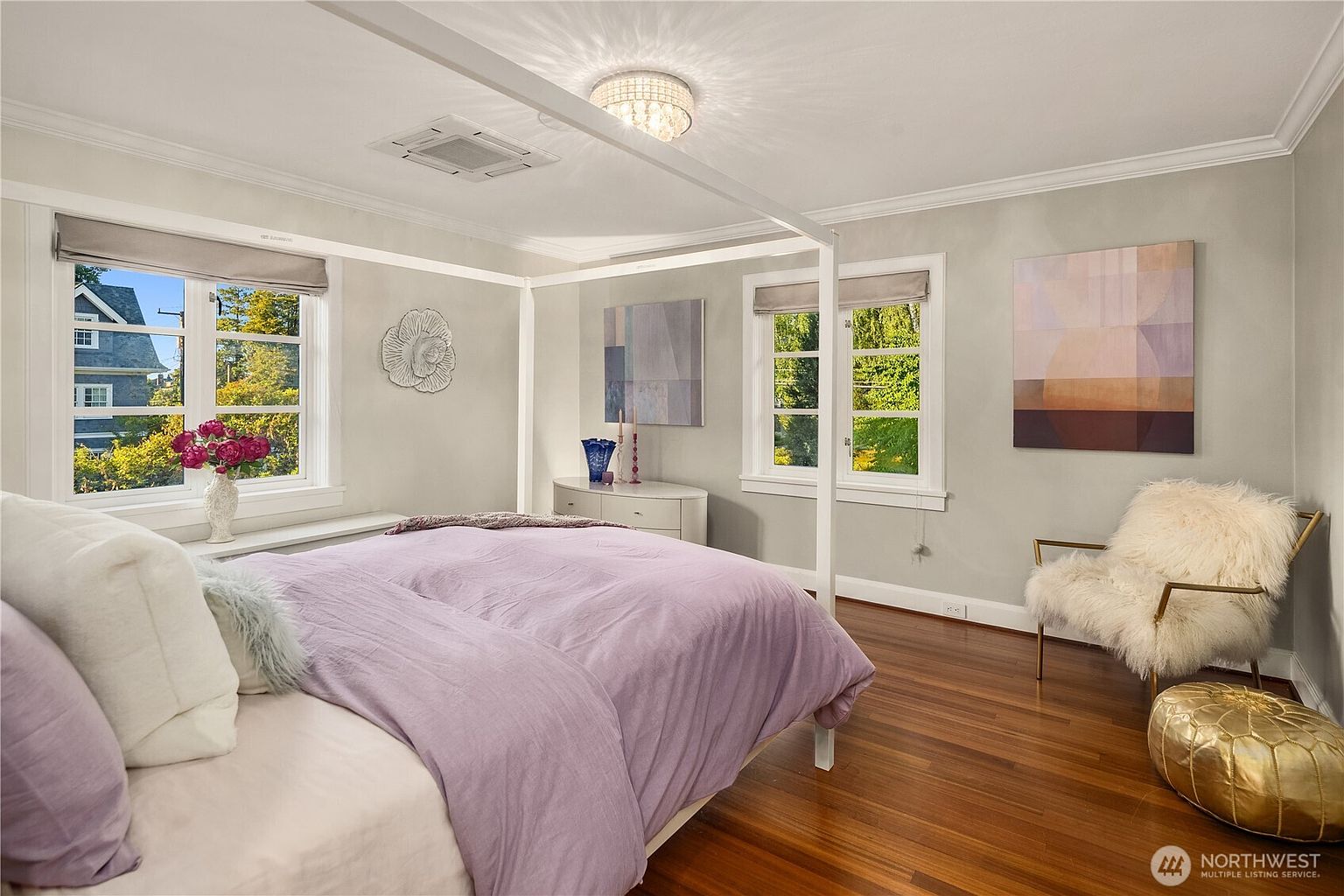
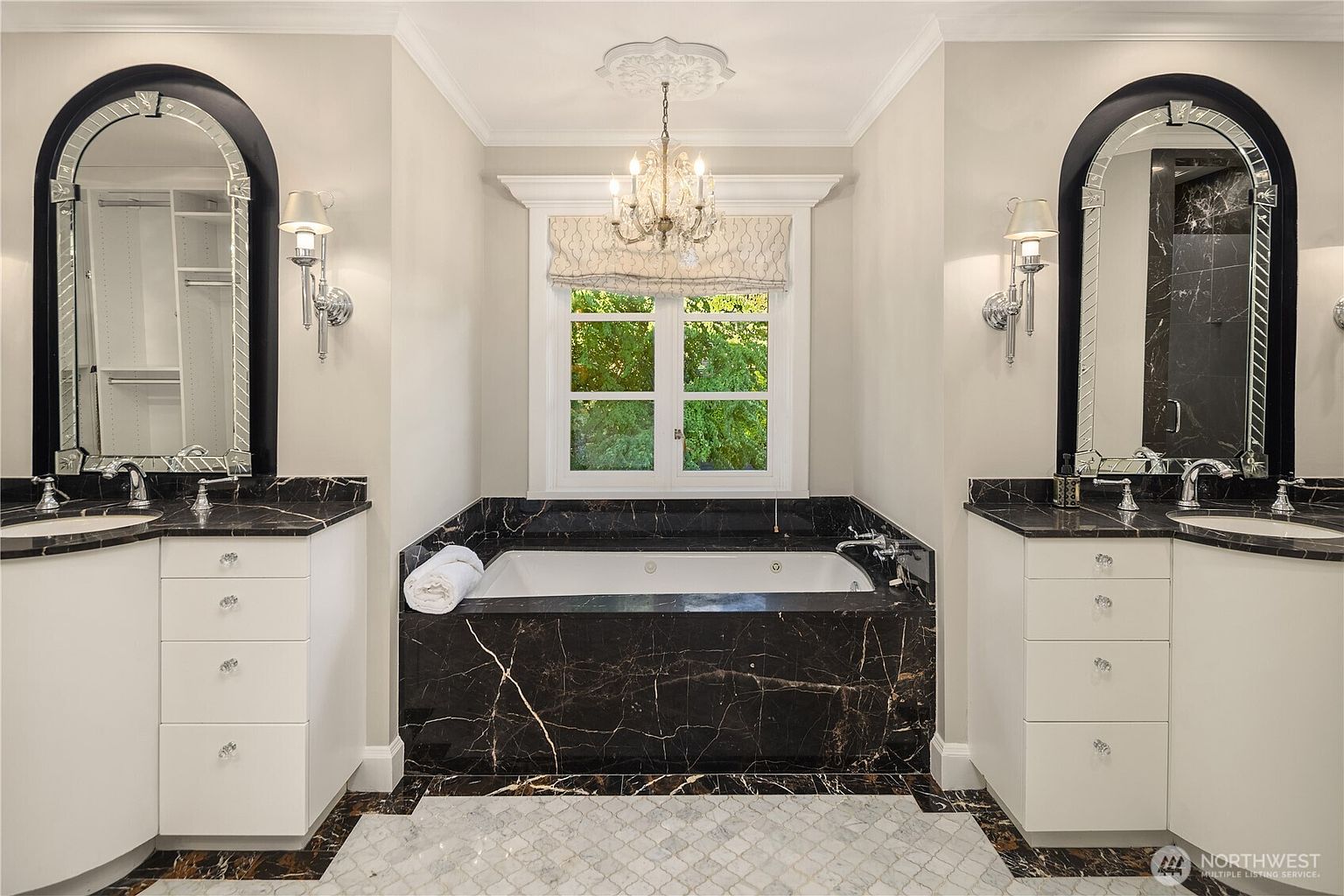
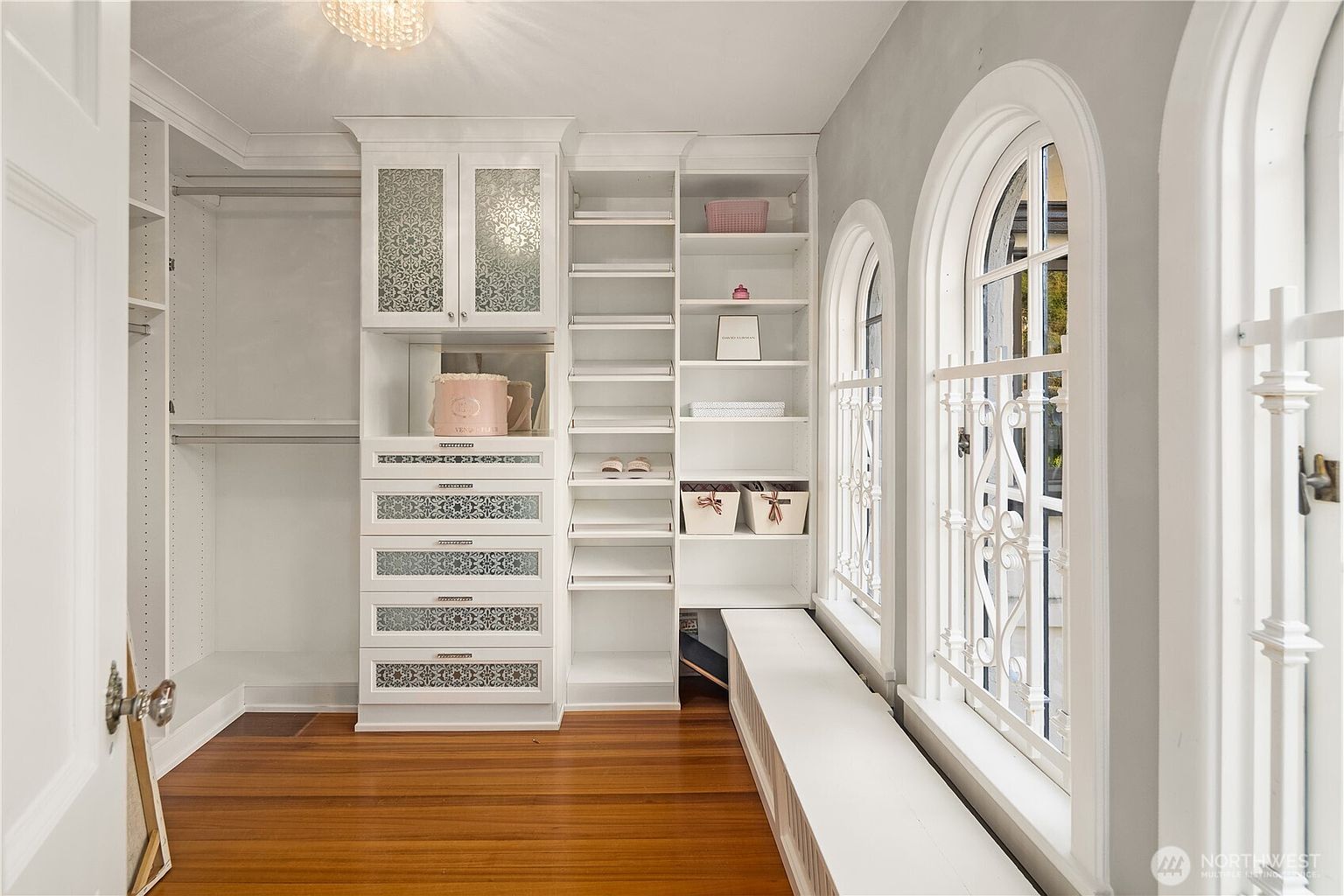
The primary suite occupies its own world: rich polished wood floors, a dark stone fireplace with a white painted mantel, a generous sitting area, and garden outlooks that soften the boundary between interior and landscape. The primary bathroom achieves a spa-like symmetry with dual vanities, a soaking tub set against a window, dark veined stone surfaces, and a crystal chandelier suspended from a decorative medallion overhead. A bespoke walk-in closet, lined with custom cabinetry and bathed in natural light through arched windows, completes the retreat.
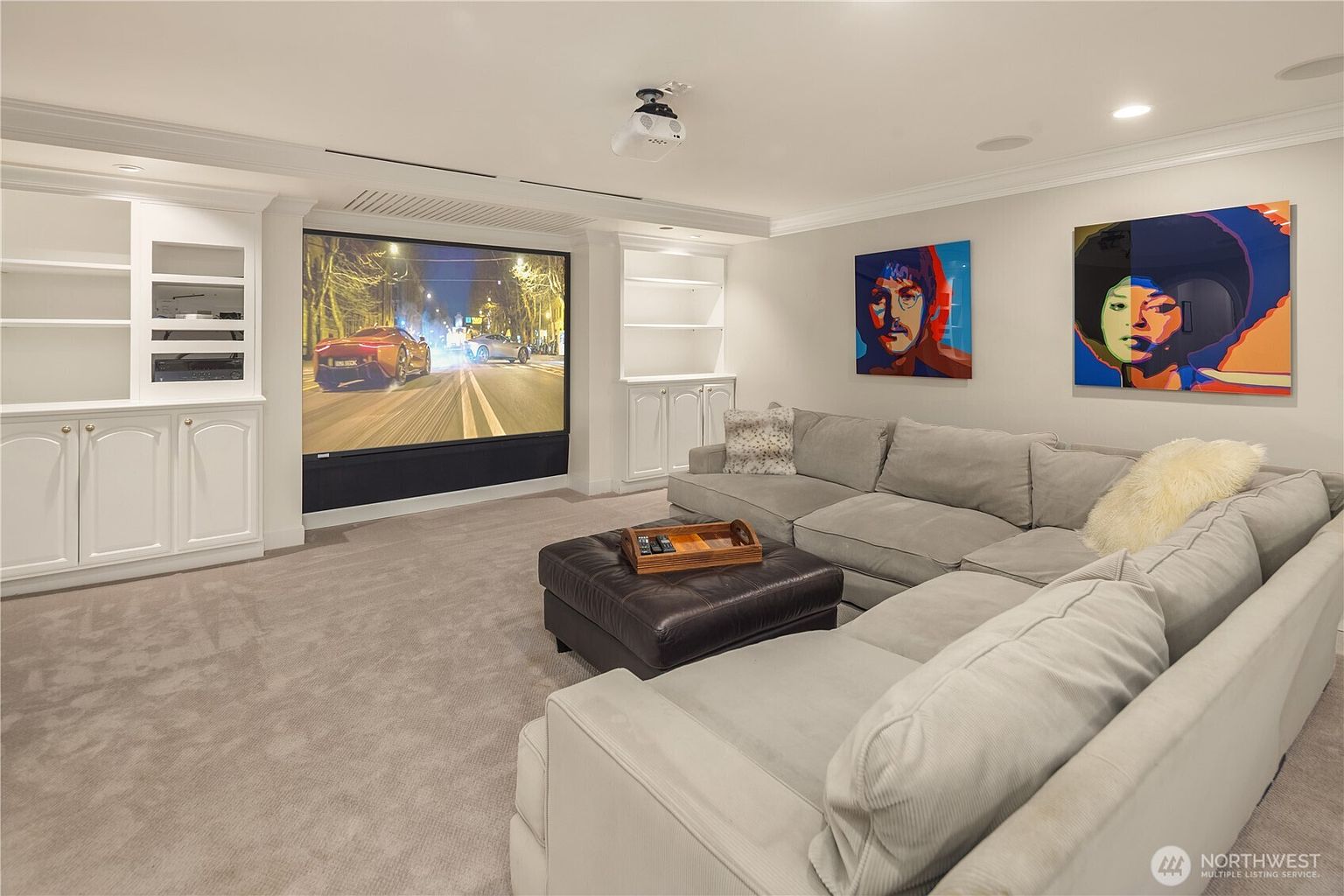
The lower level reveals the full breadth of the estate's amenity offering: a temperature-controlled wine cellar anchored by a natural-edge tasting table and a stone fireplace; a home theater with a large projection screen and a deep sectional; a game room complete with arcade cabinets and a wet bar; and a fully equipped fitness studio appointed with professional-grade equipment and abundant natural light.
Outdoors, the estate unfolds across a resort-inspired pool courtyard of rare urban privacy — a sparkling pool and integrated spa framed by lion statuary, lounge chairs, and manicured hedging. A covered patio with a stainless steel outdoor kitchen extends the entertaining footprint seamlessly, while a private tennis court set against a backdrop of mature trees and white stucco walls completes the picture of an estate conceived for living at the fullest possible scale.
A four-car garage, secure motor court, and separate guest quarters ensure that every practical consideration has been met with the same care applied to the home's more visible virtues. This is, in the truest sense, a complete estate — one that has been thoughtfully modernized without surrendering a single note of its original character.
North Capitol Hill occupies a singular position in Seattle's residential geography — elevated both literally and figuratively above the city it surveys, with sweeping views of Lake Union and the downtown skyline visible from its higher reaches, and a neighborhood character shaped by more than a century of architectural ambition. Federal Avenue East, in particular, has long been understood as one of the city's most distinguished residential corridors: a tree-lined street of substantial early-twentieth-century homes where Seattle's civic and cultural elite have lived for generations.
Capitol Hill itself is one of Seattle's oldest and most storied neighborhoods, established in the late nineteenth century as the city's population expanded rapidly following the Great Seattle Fire of 1889. Developers platted the hill as a fashionable residential district, and by the early decades of the twentieth century, it had attracted the homes of prominent families, civic leaders, and the architects who designed for them. That heritage is still legible in the neighborhood's built environment — in its Victorian-era mansions, its Craftsman bungalows, its Mediterranean Revival estates, and the mature street trees that have grown to cathedral scale over a hundred years.
The neighborhood's cultural life is among the richest of any residential district in the Pacific Northwest. Volunteer Park — designed by the Olmsted Brothers landscape architecture firm and completed in the early 1900s — sits at the heart of North Capitol Hill, its 48.3 acres encompassing a conservatory, a water tower with panoramic views, a wading pool, and the Seattle Asian Art Museum, which occupies a landmark Art Deco building completed in 1933. The park functions as the neighborhood's living room: a place for morning runs along elm-lined paths, summer picnics on open lawns, and quiet contemplation in the conservatory's tropical warmth.
Beyond Volunteer Park, Capitol Hill's commercial and cultural infrastructure is both walkable and world-class. Broadway — the neighborhood's main commercial spine — offers a concentrated stretch of restaurants, coffee shops, and boutiques that reflect the area's creative, independent character. The neighborhood is home to a thriving restaurant scene that has drawn national recognition, with numerous acclaimed chefs choosing Capitol Hill as the address for their flagship dining rooms. Pike/Pine, the neighborhood's arts corridor, remains one of Seattle's most culturally vital streets, lined with independent music venues, galleries, and some of the city's most celebrated cocktail bars.
For families, the location offers access to some of Seattle's most respected private and public educational institutions, while proximity to the University of Washington — approximately two miles to the north — places world-class research, performance, and athletic programming within easy reach. Seattle Children's Hospital and Swedish Medical Center are both within the broader Capitol Hill and First Hill corridor, adding to the neighborhood's practical appeal.
Connectivity is effortless: Capitol Hill Station on Seattle's Link Light Rail places downtown, South Lake Union, and Sea-Tac Airport within minutes, while the neighborhood's central position within the city makes it equally convenient to the Eastside, Bellevue, and the broader metropolitan region. For those who prefer to arrive by water, Lake Union — visible from the heights of Capitol Hill — offers seaplane service connecting Seattle to the San Juan Islands and Victoria, British Columbia.
To live on Federal Avenue East is to inhabit the very best of what Seattle has historically aspired to be: a city of natural grandeur, cultural sophistication, and architectural ambition, all concentrated on a single street where the past and present coexist with remarkable grace.
Featured Highlights
Curated Content • Presented by Jay H Kipp