The Story Behind
A Singular Glass-Sheathed Penthouse Above Tribeca's Skyline
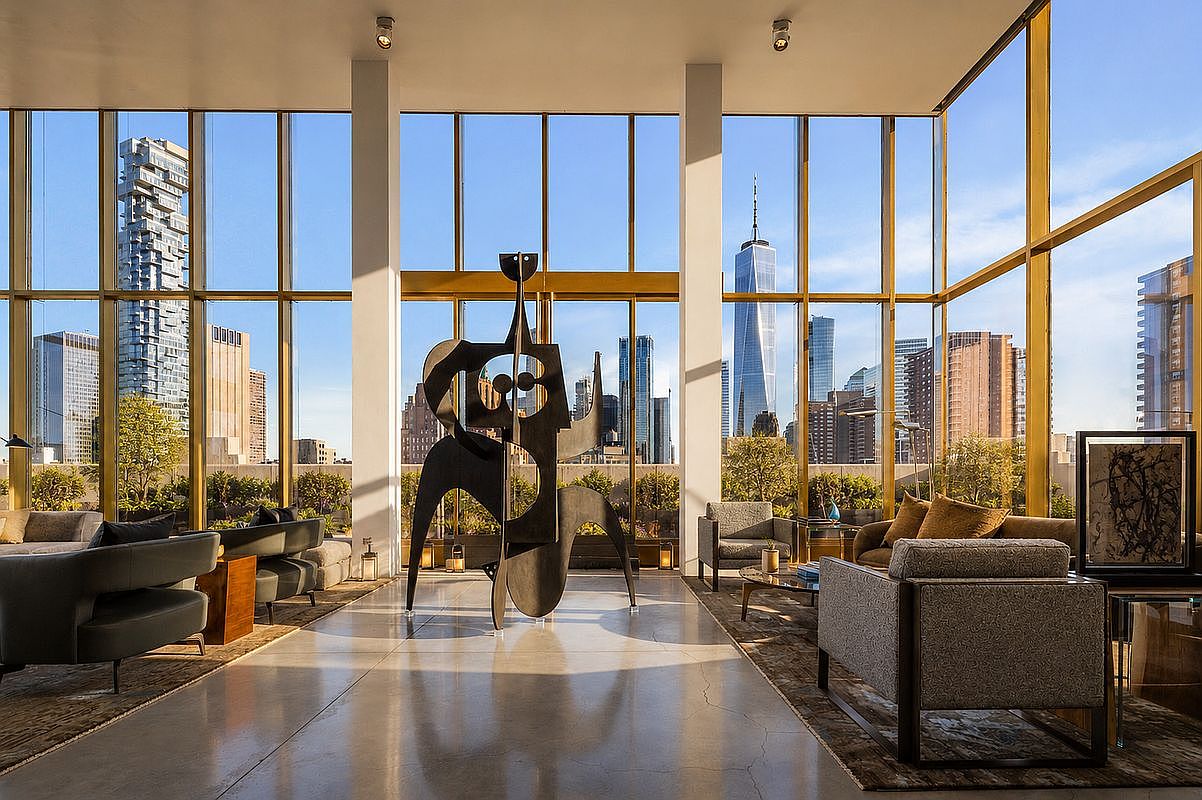
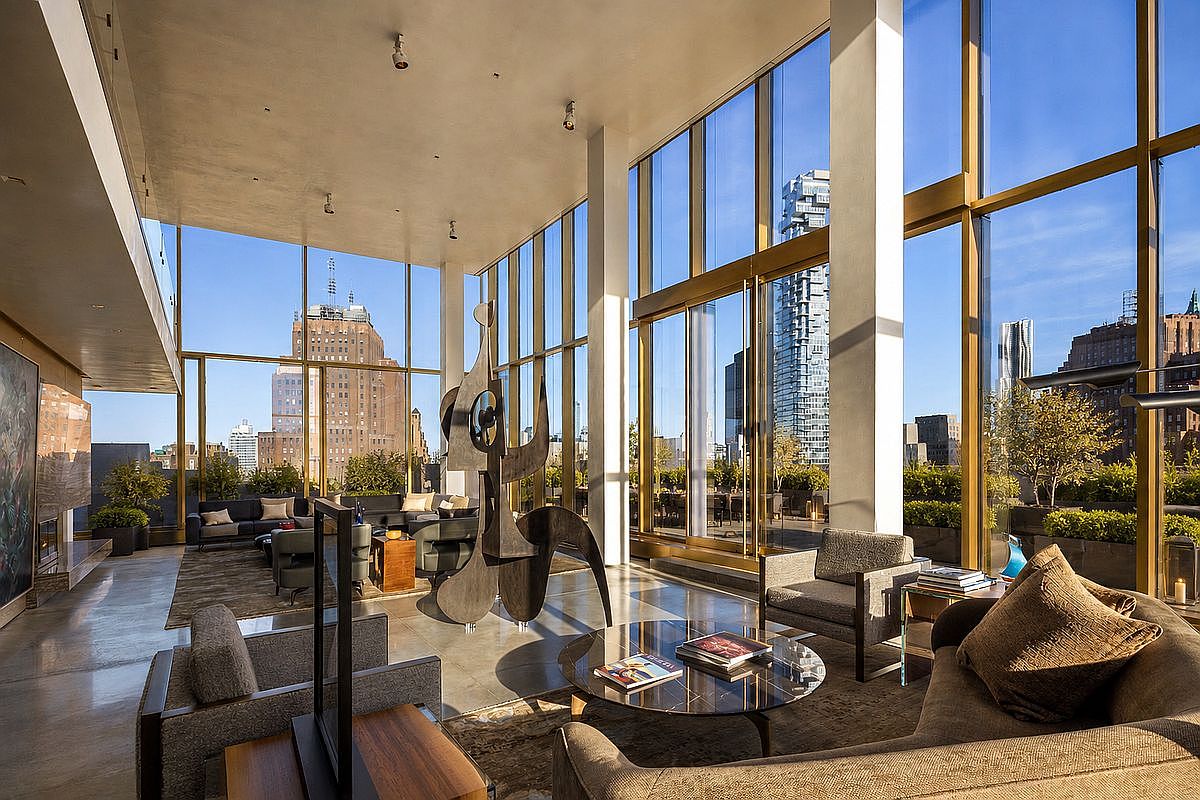
There are residences that merely occupy space atop a building, and then there are those that define it. The penthouse at 145 Hudson Street belongs emphatically to the latter category — a work of architectural and interior ambition that announces itself from the moment the private key-locked elevator doors part to reveal an 18-foot double-height great room suffused in south-facing light.
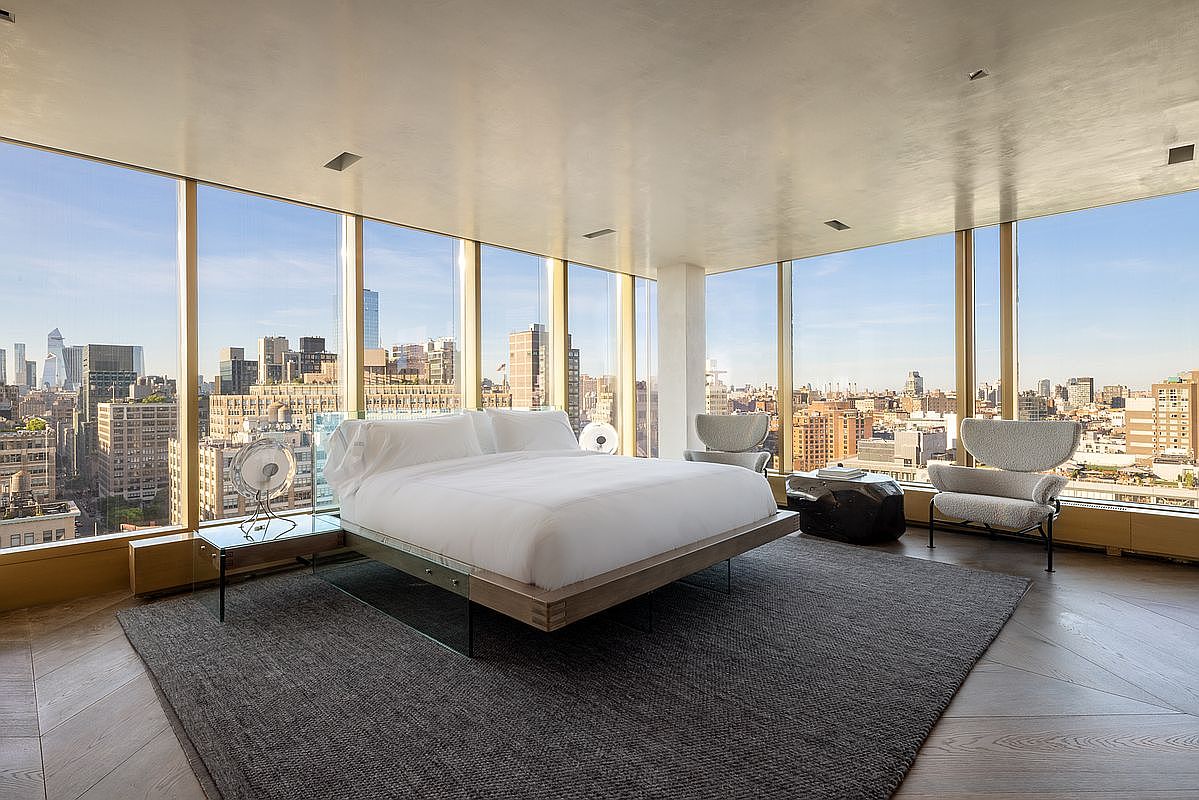
The structure was conceived by James Carpenter, a New York-based architect and artist renowned for his pioneering investigations into light, glass, and material transparency. His signature is unmistakable here: the entire façade is sheathed in UV-coated, high-performance, museum-quality insulated glass — a technical achievement that filters and purifies natural light while protecting the interiors from heat and ultraviolet degradation. The result is not merely brightness, but a quality of illumination that feels curated, as though the sky itself has been brought indoors on permanent loan.
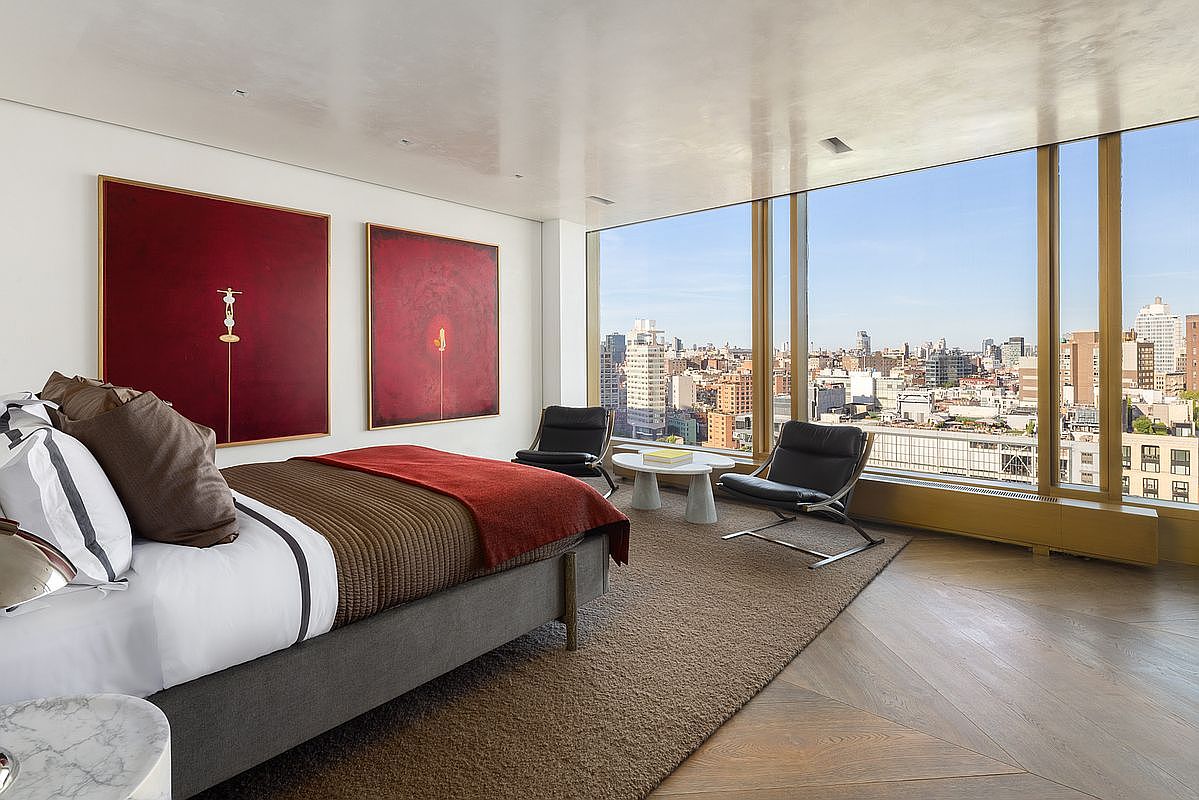
The interiors, overhauled by the acclaimed team at PHDesign, are a masterclass in material restraint elevated by extraordinary craft. Custom cerused oak wall paneling and doors with brass inlay details were made to order in Italy; hardware throughout is by Nanz, finished in brass; and every wall and ceiling has been finished in hand-troweled plaster — a labor-intensive technique that gives each surface a warmth and depth that paint simply cannot replicate. Floors on the upper level are custom-fabricated Italian smoked oak, sixteen inches wide and eight feet in length, laid in an uninterrupted herringbone pattern — a feat of both sourcing and installation that underscores the standard of execution applied to every element of this home.
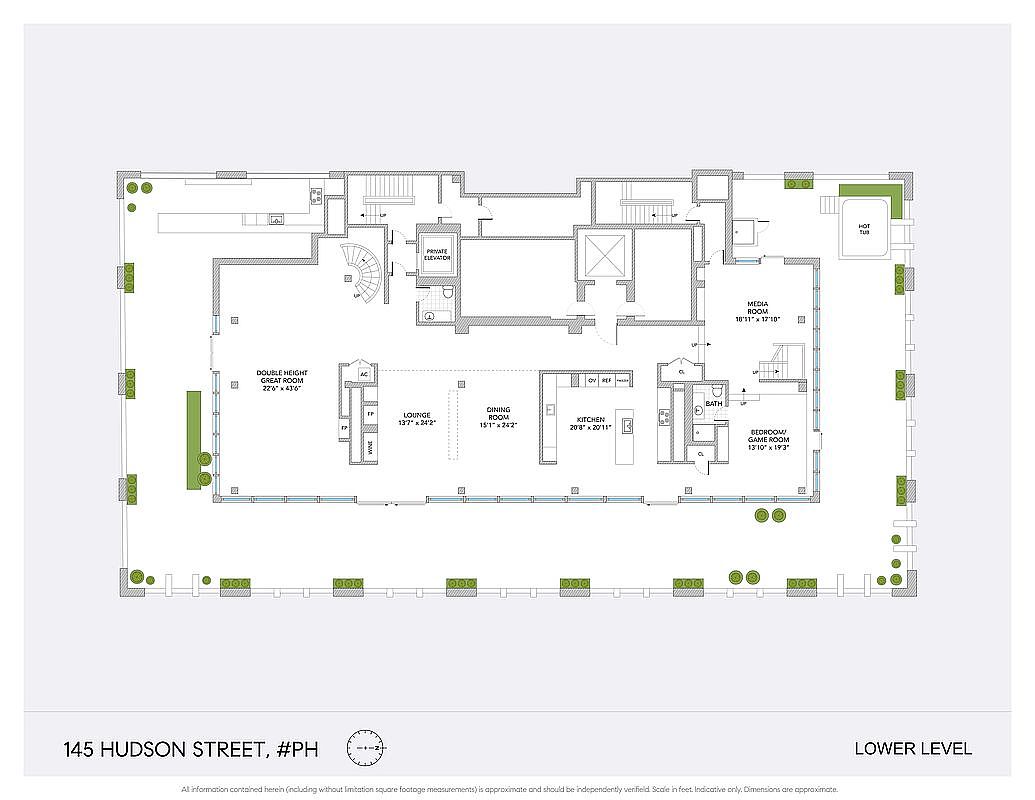
At the center of the great room, a two-story cerused oak and silver travertine hearth houses a wood-burning fireplace whose scale matches the grandeur of the space it anchors. Oversized glass sliding doors move like walls, dissolving the boundary between interior and the 4,500-square-foot wraparound terrace, which was entirely rebuilt and delivers panoramic views of the Hudson River, lower Manhattan, and One World Trade Center.
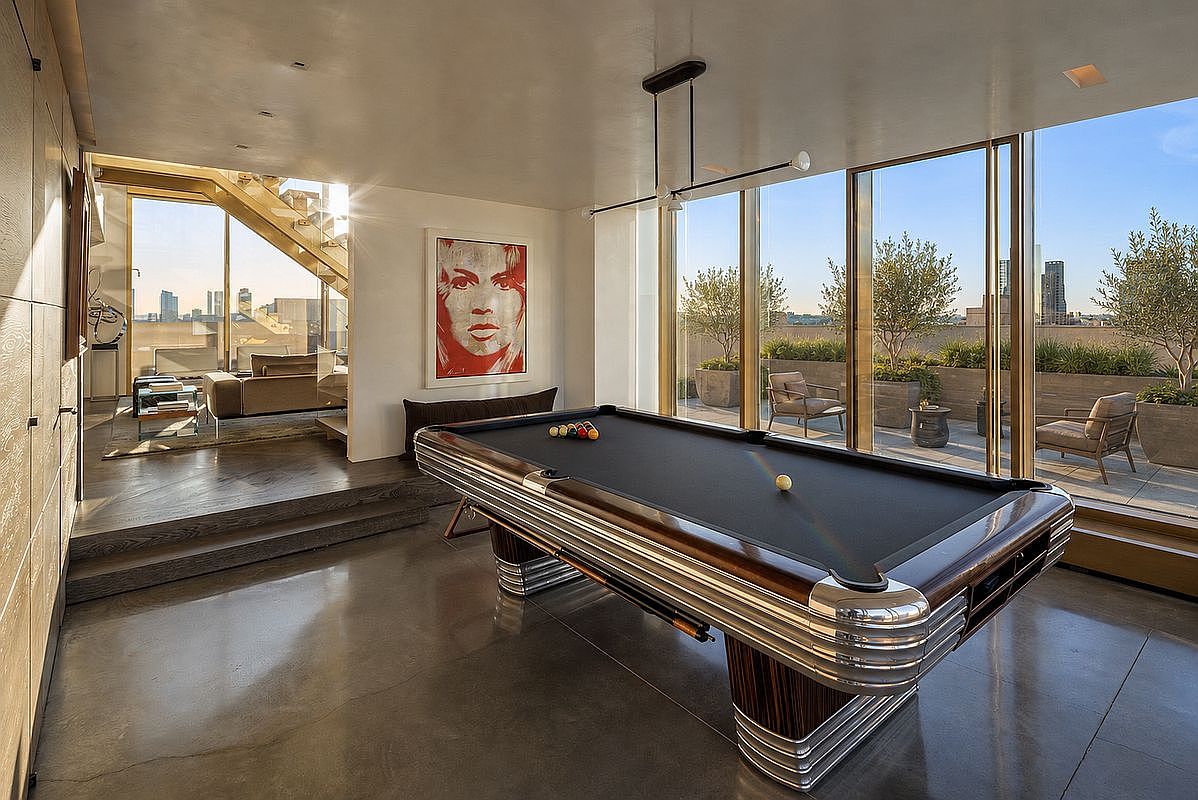
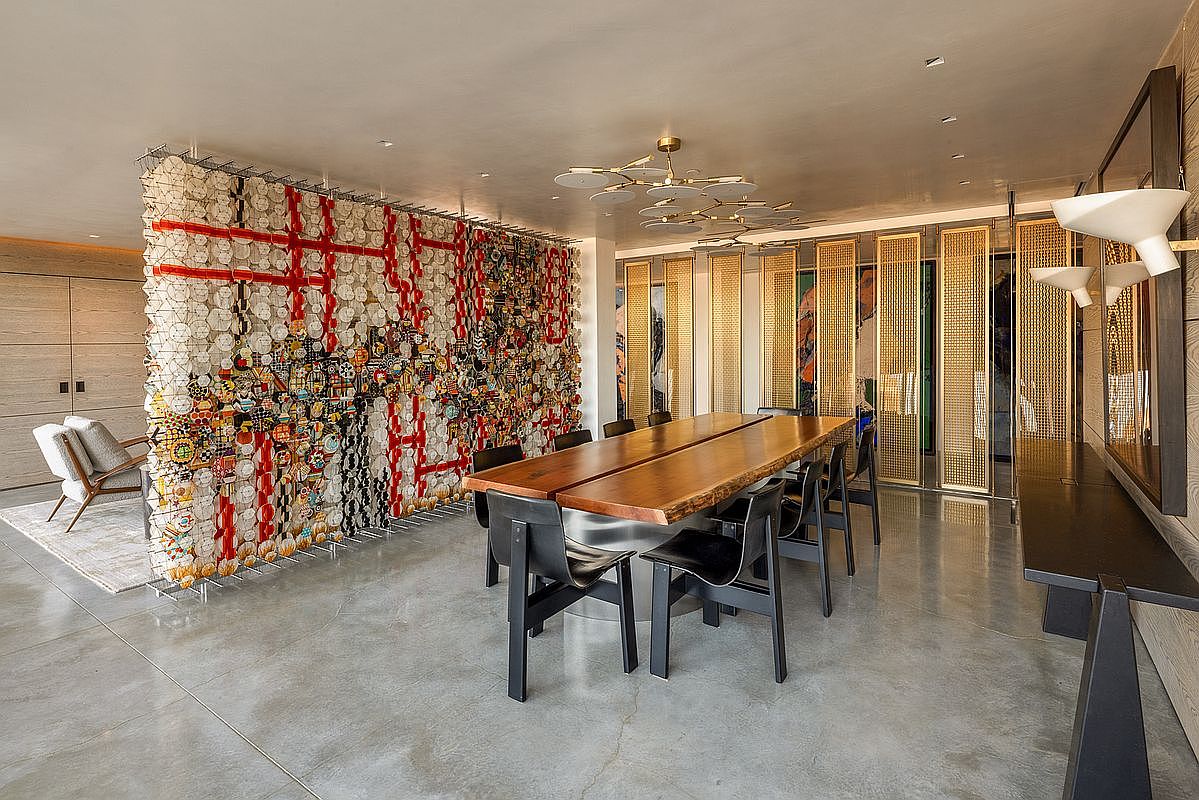
The custom chef's kitchen pairs cerused oak cabinetry with Italian Stoneglass countertops, brass wall paneling and sinks, and professional-grade Gaggenau appliances — a composition that is equal parts culinary workshop and design object. The entertaining level is further enriched by a den with a second wood-burning fireplace, a formal dining room, a dramatic double-height library and media room, and a game room with en-suite bath readily adaptable as a fourth bedroom.
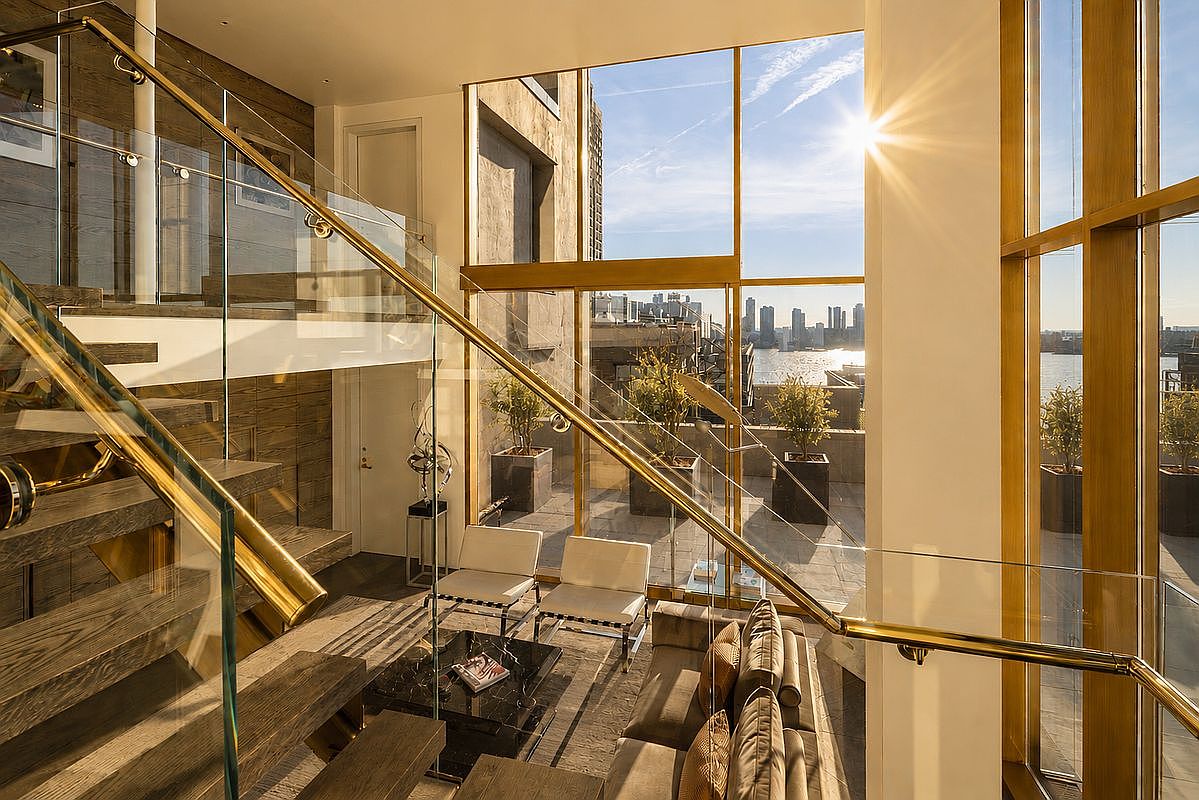
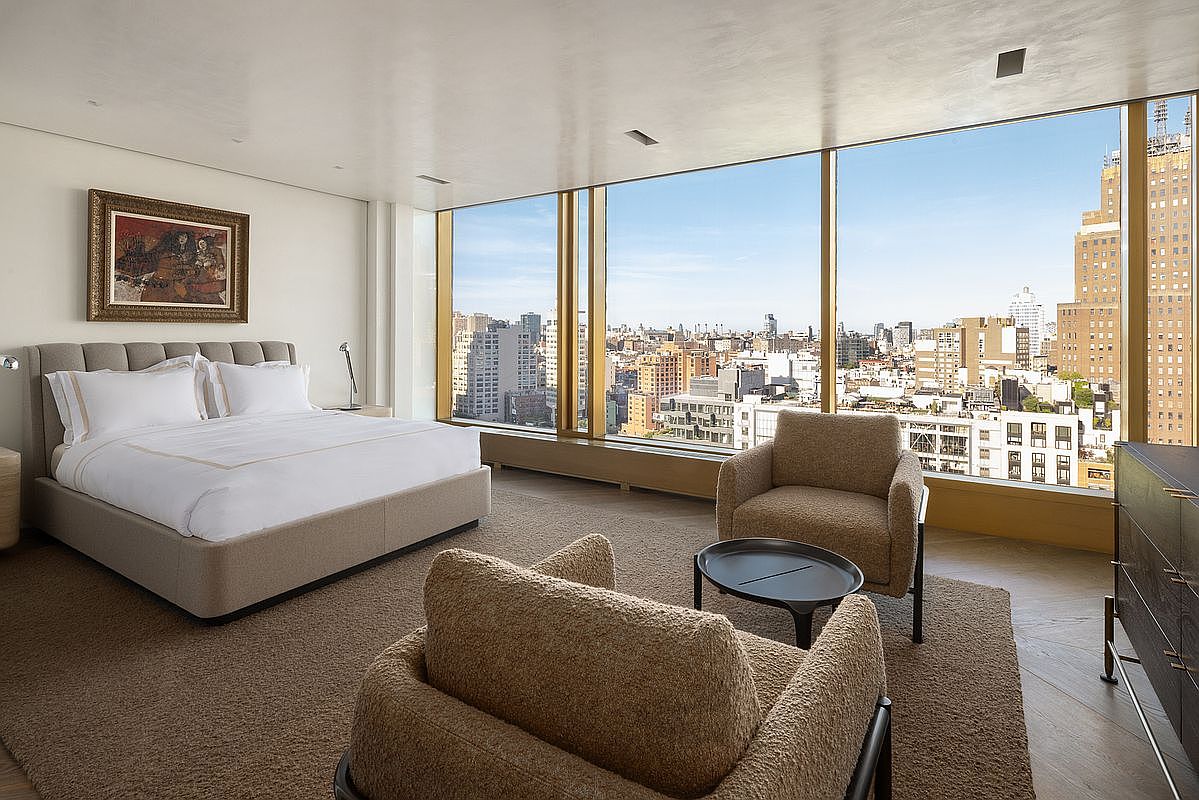
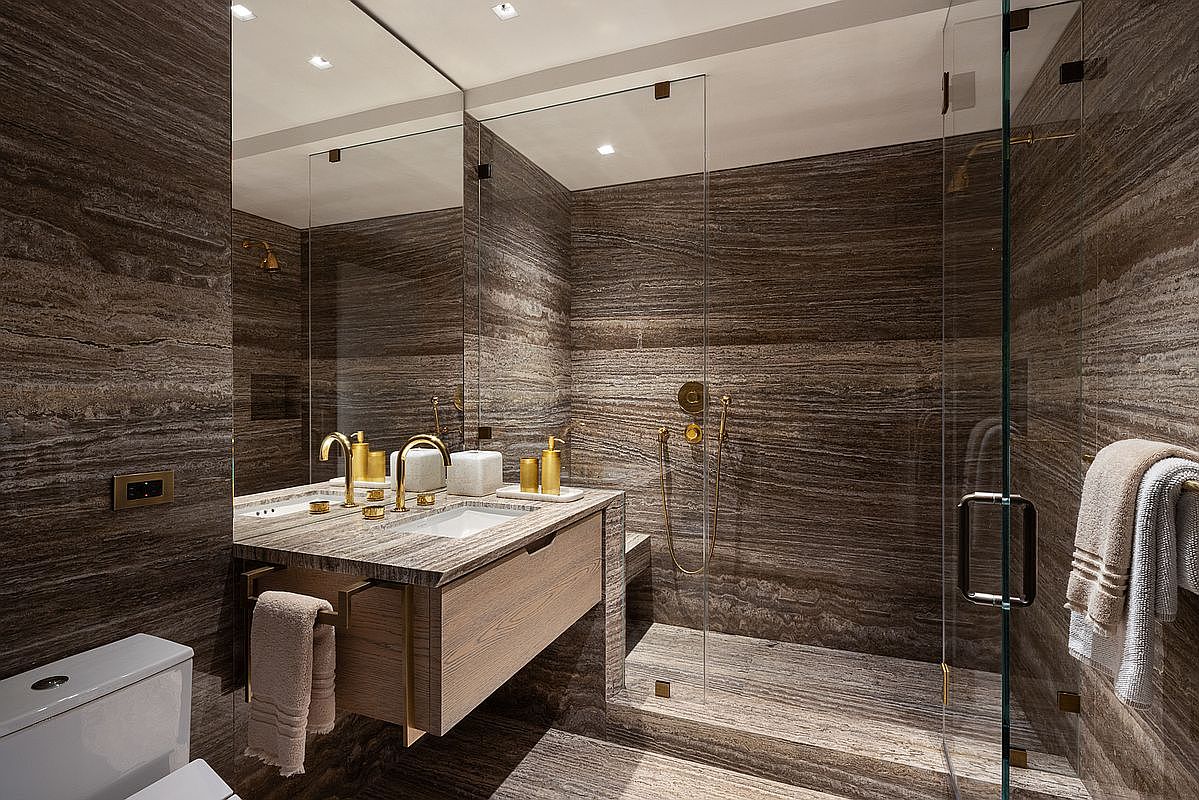
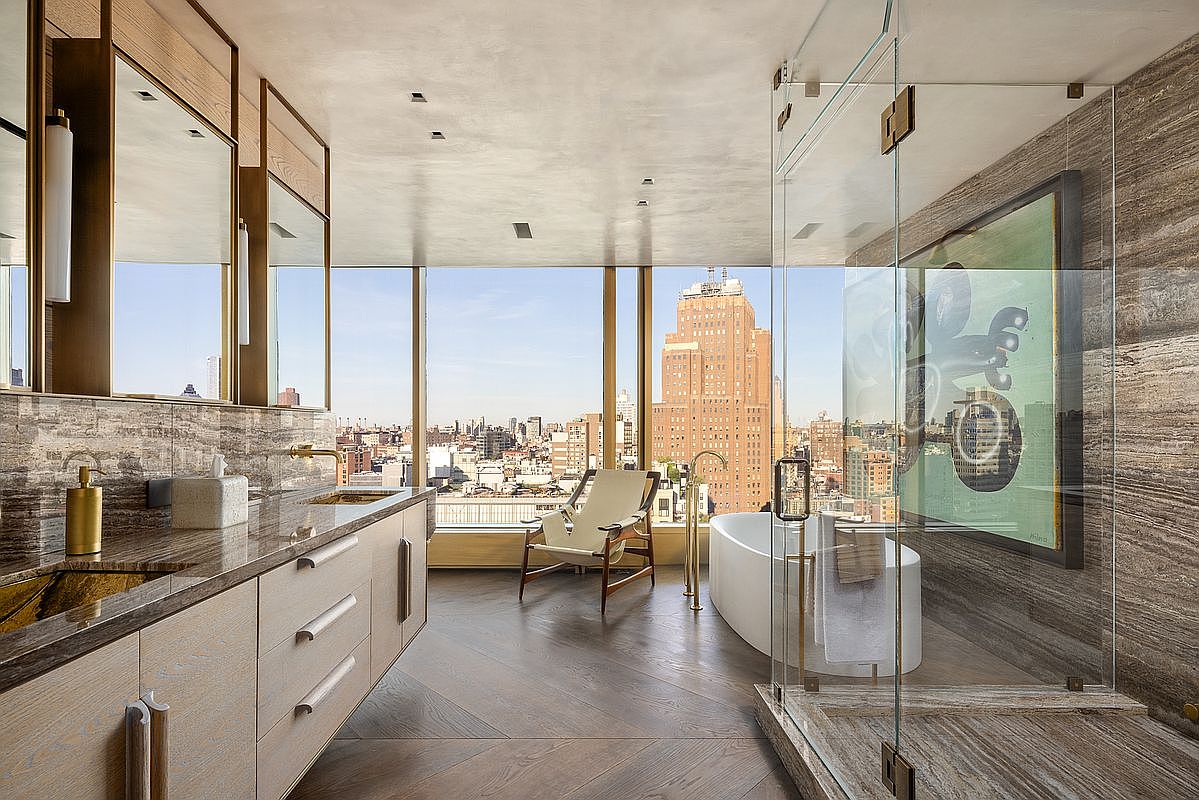
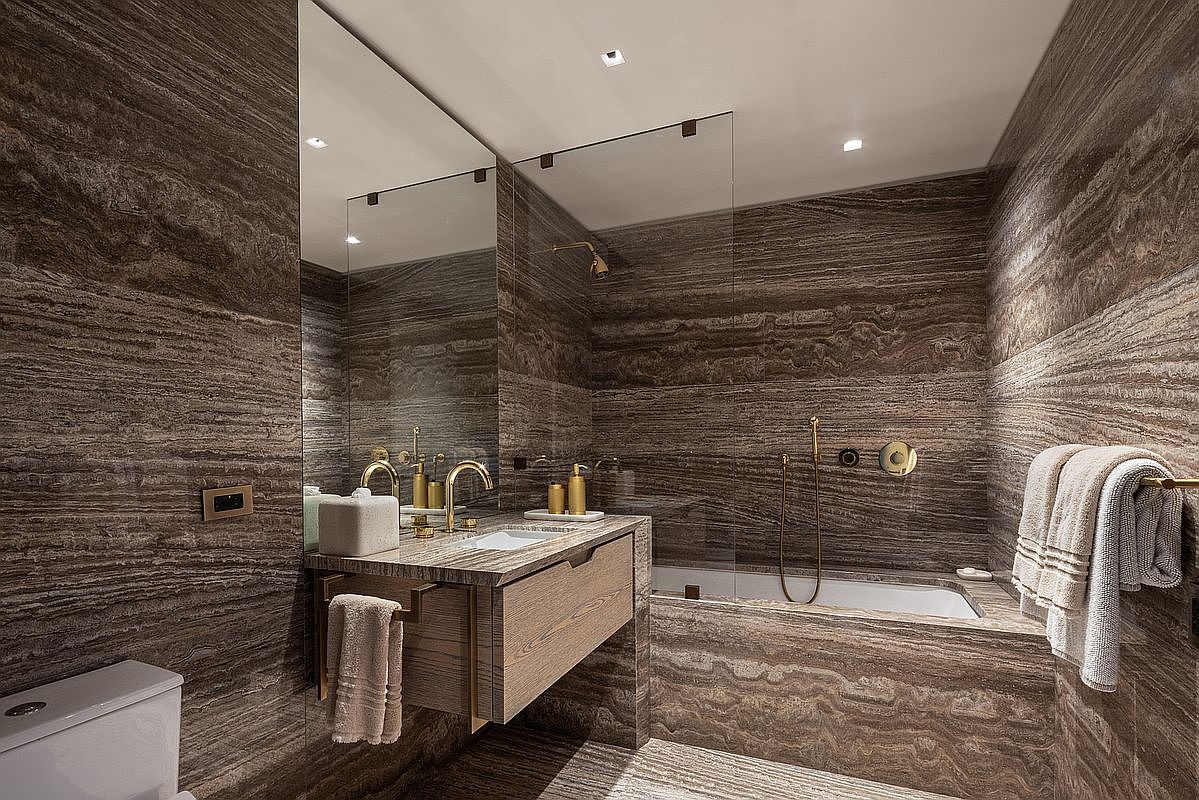
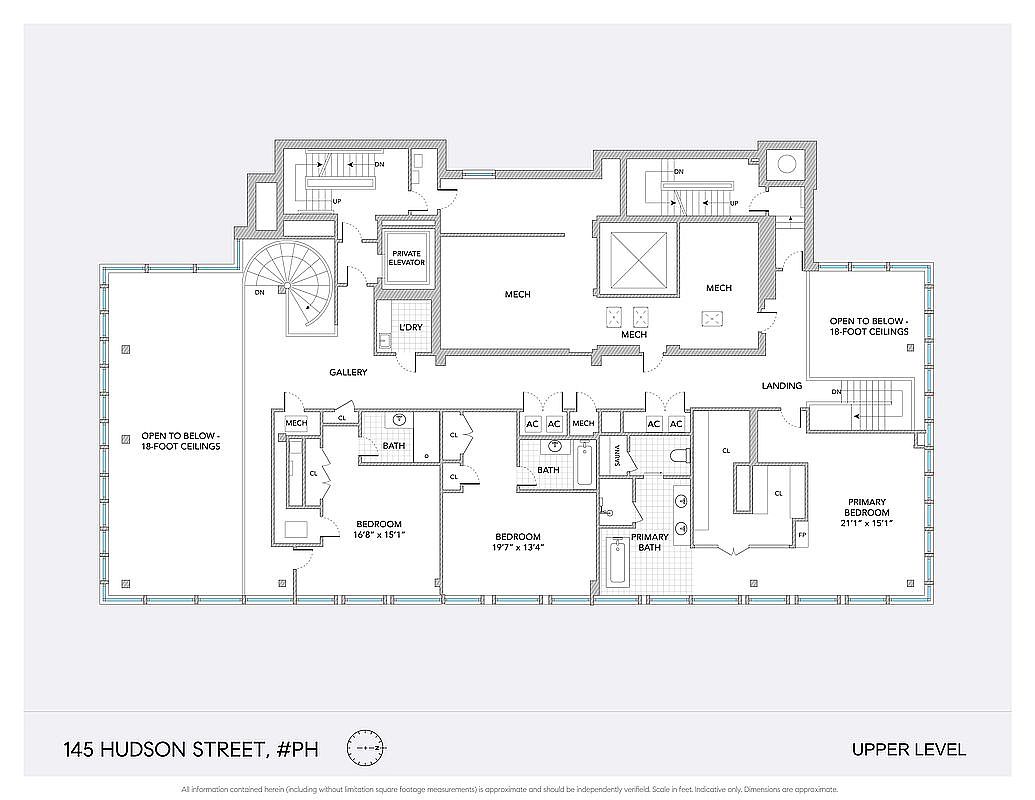
A sculptural elliptical staircase of steel and Starphire glass — one of the home's most photographed elements — connects the entertaining floor to the private bedroom quarters above. The primary suite occupies a prime corner position with direct Hudson River frontage and sweeping northern city views, anchored by a third wood-burning fireplace and a custom travertine bath appointed with a Boffi soaking tub, steam shower, and Italian brass-framed medicine cabinet. Two deep walk-in closets, clad entirely in cerused oak, complete the suite with quiet, considered luxury.
Lighting — by Holly Hunt, Michael Anastassiades, Pureedge, Henge, and Kreon — has been precisely calibrated to showcase a significant art collection, while a Lutron system governs shading and ambiance throughout. Radiant heat in every bathroom, comprehensive humidification and climate control, and a state-of-the-art security system round out a residence that is as intelligently engineered as it is beautifully composed. Three private dedicated parking spaces complete an offering that is, in every measurable sense, without peer.
Tribeca — the Triangle Below Canal Street — occupies a singular position in New York City's urban geography, both physically and culturally. Bounded roughly by Canal Street to the north, the Hudson River to the west, Broadway to the east, and Chambers Street to the south, the neighborhood was transformed over the course of the 1970s and 1980s from a post-industrial warehouse district into one of Manhattan's most coveted residential enclaves, following a path blazed first by artists and then by the architects, financiers, and tastemakers who followed them.
The neighborhood's built fabric remains one of its defining assets. Along Hudson Street and its cross streets, the cast-iron and Romanesque Revival commercial loft buildings of the late nineteenth century — many now protected as part of the Tribeca Historic Districts — lend the area a solidity and grandeur that newer construction rarely matches. At 145 Hudson Street, the Sky Lofts Condominium occupies one such landmark structure, its industrial brick base now crowned by James Carpenter's luminous glass penthouse addition — a pairing that captures the neighborhood's essential character: history and modernity in productive, elegant tension.
At street level, Tribeca functions as one of Manhattan's most livable neighborhoods, a quality that has consistently attracted families alongside the creative and professional communities that first settled here. Hudson Street itself is a spine of daily life — lined with destination restaurants, independent boutiques, and the kind of unhurried sidewalk culture that feels increasingly rare in central Manhattan. The Tribeca Farmers Market, held at Greenmarket locations in the area, reflects the neighborhood's longstanding commitment to quality and community.
The culinary landscape is exceptional by any measure. Tribeca is home to some of New York's most enduring and celebrated restaurants, and the neighborhood's proximity to Hudson Square and the West Village extends that dining culture further still. The Hudson River Park, stretching along the western edge of the neighborhood, provides acres of open parkland, waterfront promenades, and recreational facilities — a green amenity of extraordinary quality for a dense urban setting. The park's Pier 25 offers a playground, mini golf, and a beach volleyball court, while Pier 26 is home to a tidal estuary and ecological education center.
For families, Tribeca has long been regarded as one of the most desirable school districts in Manhattan, with highly regarded public and private educational options in close proximity. PS 234 Independence School, a short walk from 145 Hudson, consistently ranks among the city's most sought-after public elementary schools.
Culturally, the neighborhood is anchored by the Tribeca Film Festival, which has made the area an annual focal point for cinema and the arts each spring, and by a robust gallery scene that has evolved organically from the neighborhood's artistic origins. The nearby Oculus and Brookfield Place add world-class retail and dining to the immediate radius, while the memorial and museum at One World Trade Center — visible in its full, unimpeded majesty from the penthouse terrace — lend the neighborhood a weight and resonance that few addresses in any city can claim.
Featured Highlights
Curated Content • Presented by Jim St. Andre